|
|
| St. Augustine FL, Movement — 1963 |
| Savannah GA, Movement (June-Dec) |
| Farmville VA and the Program of Action (July-Sept) |
| Struggle for the Vote Continues in Mississippi (July-Aug) |
| Savage Repression in Gadsden AL (Aug) |
| Americus GA Movement & "Seditious Conspiracy" (July-Aug) |
| Federal "Jury Tampering" Frameup in Albany GA (Aug) |
| Kennedys Appease the Segregationists (Aug) |
| Man-Hunt in Plaquemine LA (Aug-Sept) |
| Orangeburg SC, Freedom Movement (Aug-Sept) |
| March on Washington for Jobs & Freedom (Aug) |
| Birmingham Church Bombing (Sept) |
| Freedom March in New Orleans (Sept) |
| Mary Hamilton and the "Miss Mary" Case (Sept) |
| FBI's COINTELPRO Targets the Movement (Oct) |
| Freedom Day in Selma (Oct) |
| Free Southern Theater (Oct) |
| Freedom Vote in MS (Oct-Nov) |
| Assasination of President Kennedy (Nov) |
| SNCC Meets Kenyan Freedom Fighter in Atlanta (Dec) |
Saint Augustine is a small town of 15,000 on Florida's Atlantic coast, just south of Jacksonville and not far from the Georgia border. Roughly 75% white and 25% Black, it is still a thoroughly segregated community in 1963. A tourist town, its motels, restaurants and beaches are "white-only," and almost a decade after Brown v. Board of Education its schools are still segregated — only six Black children attend a "white" school.
Founded in 1565 by Spanish colonizers, St. Augustine claims to be "the oldest city in America" — meaning, of course, the oldest city settled by Europeans because some of the pueblo towns of the Southwest date back to the 11th Century or earlier. Until the Civil War, St. Augustine was a slave trade center, and when the town became a vacation destination in the 1890s the Old Slave Market was turned into a tourist attraction.
Lincolnville is St. Augustine's Black neighborhood and Mrs. Fannie Fullerwood — who works as a maid for a white family — is president of the local NAACP. In March of 1963, she sends a letter to President Kennedy and Vice President Lyndon Johnson asking them to reject a large financial grant requested by the city for a segregated celebration of its 400th anniversary. With Greenwood and Birmingham on front pages around the world, LBJ replies that: "No event in which I will participate in St. Augustine will be segregated." But what does that mean? Does it mean that places and events will be temporarily desegregated while he is present, or does it mean he will only participate in locations that have been permanently integrated?
Intense negotiations between the local NAACP, St. Augustine's white power-structure, and LBJ's representatives ensue. LBJ comes to town for a banquet, and for the first time in history, Blacks enter the lavish Ponce de Leon Hotel ballroom as guests rather than maids or bus boys (they are seated by themselves at two "Negro" tables). But St Augustine's restaurants, lunch counters, motels, and other facilities remain segregated, as does the Ponce de Leon after the Vice President leaves. And the next day when NAACP leaders show up for a promised meeting with the City Commission, they are shown to an empty room with a tape recorder. They are told to record their complaints because no white official will meet with them in person.
By early June, the hope that had soared at the time of LBJ's visit is
dying. Nothing has come from the tape-recorded grievances, and so far
as the city is concerned, the 400th anniversary celebrations are going
to be on a segregated basis. Dr. Robert Hayling, a young Black dentist
recently arrived in the city, becomes head of the St. Augustine NAACP
Youth Council (SAYC). He had been active with the
Nashville Sitin Movement in 1960
while a dental student at Mehary Medical College, and he announces
that unless there is some tangible progress, the young people of St.
Augustine are ready to begin nonviolent direct action like those in
Birmingham. A few days later he leads small groups of pickets at the
local Woolworths to protest segregation. They carry signs reading:
"If We Spend Money Here Why Can't We Eat Here?"
The Klan threatens to kill Hayling. Hayling tells a reporter: "I and others have armed. We will shoot first and ask questions later. We are not going to die like Medgar Evers." The local press, which has ignored the Black community and issues of segregation, seize on his remark, sensationalizing it to mean that Blacks are arming to attack innocent whites. National leaders of the NAACP repudiate Hayling's statement as a provocation. They assure the FBI that they are working to silence Hayling.
In July, sixteen SAYC members sit-in at the segregated counter and are arrested. Seven of them are younger than 17 and thus legally classified as juveniles. Charles Mathis, the local judge, denies them bail. He refuses to release them unless their parents sign a promise that they won't demonstrate until they reach age 21. Four of the families refuse to agree, and the "St. Augustine Four" — JoAnn Anderson Ulmer, Audrey Nell Edwards, Willie Carl Singleton, and Samuel White — are sent to state reform schools. When an NAACP attorney tries to free them, Judge Mathis claims that they are beyond the jurisdiction of the legal system. The young teenagers remain locked up for six months, away from their parents and out of school, until January 1964 when pressure on the Florida governor finally wins their release.
Outraged at the indefinite incarceration of the St. Augustine Four and the continued refusal of the city to appoint a biracial commission or meet with Black leaders, Dr. Hayling leads a mass march of more than 100 adults towards the Old Slave Market on Labor Day. The police attack, arresting Hayling and 26 others.
St. Augustine is a Ku Klux Klan stronghold. Shortly after the Birmingham church bombing, the KKK led by local white-supremacist "Hoss" Manucy holds a rally and cross-burning in a nearby field. Rev. Connie Lynch of the National States Rights Party addresses 300 racists, telling them that the four young girls slain in Birmingham were: ".. old enough to have venereal diseases," and were no more human or innocent than rattlesnakes. "So kill 'em all, and if it's four less niggers tonight, then good for whoever planted the bomb. We're all better off!"
Suddenly the cry "Niggers! Niggers!" goes up. Dr. Hayling and SAYC activists Clyde Jenkins, James Hauser, and James Jackson have been caught observing the rally. They are brutally beaten unconscious with fists, chains, and clubs. Only the arrival of Highway Patrol officers prevent them from being burned alive. St. Johns County Sheriff L.O. Davis — a Klan sympathizer — arrests four whites for the beating and also arrests the four unarmed Blacks for "assaulting" the 300 armed Klansmen. Charges against the Klansmen are dismissed, but Hayling is convicted of "criminal assault" against the KKK mob.
Over the following weeks, tension escalates. The home of a Black family whose child has integrated a white school is burned. In October, a carload of KKK night riders race through Lincolnville shooting into Black homes. Blacks return fire, killing one Klansman. NAACP activist Rev. Goldie Eubanks and three others are indicted for murder. Meanwhile, disturbed by Hayling's militancy, the national NAACP removes him as head of the Youth Council. Hayling, Eubanks, Henry & Kathrine Twine, and other freedom fighters leave the NAACP and contact SCLC for assistance.
See St. Augustine FL, Movement — 1964 for continuation.
For more information on the St. Augustine Civil Rights Movement:
Articles & Speeches: St. Augustine Movement
Books: Florida Movement
Web: St. Augustine Movement
Personal stories from the St. Augustine Movement:
Barbara Barnes Allen
George Conway A Matter of Honor
Hattie & James White
See Savannah Sitins & Boycott for background and previous events.
Unlike most Deep South towns, there are some Blacks on the Savannah police force and many Blacks are registered to vote. Black votes help elect racial "moderate" W. L. Mingledorff as Mayor in 1960, and he appoints some Black representatives to city offices. After sit-ins in 1960, lunch counters and some other facilities are integrated, but not restaurants and hotels. Movie theaters are initially integrated, but in the face of rising white resistance, by 1963 they have re-segregated.
Inspired by Birmingham, Savannah demonstrations resume in June of 1963, this time calling for complete desegregation of all facilities. Three key leaders guide the revitalized Savannah Movement:
Starting in June, marches, ralies, sit-ins, wade-ins, and other forms of nonviolent protest become common occurances in Savannah. At the center of the action is First African Baptist Church — perhaps the oldest Black church in North America (founded in 1775 before the Revolutionary War) — a church long in the forefront of the freedom struggle.
There are some incidents of police violence and attack dogs used against demonstrators, but there is no widespread, systematic police repression on the model of Birmingham, Danville, or Gadsden. The Mayor and other civic leaders meet with Blacks including those from the movement. Following a noon protest in Johnson Square on June 11, for example, Ben Clark leads hundreds of marchers to City Hall. Many of them are invited in to meet with the Mayor.
A white woman complains that the protests frighten her and keep her awake at night. Hosea Williams is arrested for this "crime," other whites add similar charges, and his bail is set at the astronomical sum of $35,000 (equal to $360,000 in 2024). Unable to raise this outrageous amount, he languishes in jail for 65 days — the longest continuous incarceration of any major Movement leader of the time — until the president of a local bank bonds him out.
In July, 75 protesters are arrested on a night march. The city bans marches, and the Georgia National Guard is alerted. 1,000 demonstrators rally in front of a segregated Holiday Inn, then march towards the jail where previously arrested demonstrators are being held. Police and Georgia State Troopers attack with clubs and tear gas, arresting almost 300. Nonviolent discipline breaks down, and some bottles and bricks are thrown.
In August, the city and the movement reach a new desegregation agreement to be phased in over time. The planned Christmas boycott of white merchants is cancelled. An influential "Committee of 100" is formed of white business and community leaders who accompany Blacks to segregated facilities which soon change their policies. By October, Savannah is largely desegregated some eight months ahead of the Civil Rights Act of 1964. Dr. King is invited for a New Year's address in Municipal Auditorium where he says: "[Savannah is] the most desegregated city south of the Mason- Dixon line."
King recruits Hosea Williams to the SCLC Executive Staff where he becomes one of SCLC's most important direct action leaders. Ben Clark also joins the SCLC staff and continues to work closely with Hosea.
For more information on the Savannah Civil Rights Movement:
CRMVets: Siege at Savannah
Book: Weary Feet, Rested Souls... (pages 179-188)
By 1963, the embattled Black community of Prince Edward County VA has been struggling against segregated schools for more than a dozen years, ever since the Student Strike at Moton High in 1951 resulted in one of the initial school desegregation cases decided by the Supreme Court's Brown v. Board of Education decision in 1954. Though Brown was an important legal victory against the entire concept of racial segregation, as a practical matter southern schools remained segregated while the white South fought back with its "Massive Resistance" campaign. Rather than accept integration, Prince Edward county's white power-structure closed the entire school system in 1959, leaving Blacks with no access to public education at all while white children continued to be schooled in "private" (yet state-supported) white-only "acadamies."
Schools are not the only issue in Prince Edward County. In 1963, Blacks make up roughly 40% of the population but there are no Afro-Americans in any public office, no Black cops, firemen, managers, or clerks on the public payroll. For the most part, Blacks are restricted to the lowest-paid and most menial of occupations and on average earn less than half of what whites earn. Poverty among Blacks is wide-spread. Throughout the county and the town of Farmville segregation is the rule with "white-only" restrictions, "colored" entrances and drinking fountains, and a maze of race-related rules, customs, and restrictions.
Rev. Francis Griffin of First Baptist Church in Farmville is the acknowledged leader of the Black community. He is head of the local NAACP branch and president of the Prince Edward County Christian Association (PECCA) which is the Black community's main political organization. He's known as the "fighting preacher" because he believes that, "All forms of worship should be related to a form of action." Throughout the 1950s, he leads the fight for education, holding the community together in support of the NAACP lawsuits and struggling to provide some alternate methods of education for Black children without access to a public school system.
Nationally, the NAACP's strategy is oriented around litigation and legislation, not direct action protests like sit-ins, freedom rides, and mass marches. In 1961, for example, SCLC's Virginia Christian Leadership Conference proposes a sit-in on Congress to dramatize the situation in Prince Edward County and the nation's failure to implement the Brown decision. Their call is supported by CORE and other civil rights groups. But, conforming to the NAACP's anti-direct acton stand, Griffin and PECCA veto the plan.
In 1960, the Greensboro Sit-In sparks a storm of student activism across the South, a storm that begins to erode the NAACP barriers against direct action. The national leadership has always allowed local NAACP branches to engage in selective-buying campaigns (boycotts) such as the Montgomery and Tallahasee bus boycotts and the merchant boycotts in Tuskegee and New Orleans. Through boycott actions, young NAACP activists create an organizational space for some forms of protest. In Jackson, for example, the NAACP Youth Council engages in picketing — which in Mississippi is a form of civil disobediance leading to immediate arrest — to build support for a Christmas boycott of white merchants. And elsewhere, other NAACP youth groups also begin using direct action tactics to support voter registration and desegregation efforts.
In the Fall of 1962, Rev. Griffin is elected president of the Virginia State Conference of the NAACP. He states, "[It is] imperative that all phases of the Association's program be strengthened and accelerated." In the Spring of 1963, SCLC's Birmingham campaign shakes the nation and triggers a tidal wave of mass protest across the South — not just students sitting-in at lunch counters but a broad challenge to segregation in general. Cities like Durham, Greensboro, Jackson, St. Augustine, Savannah, Gadsden, Americus, Orangeburg, New Orleans and elsewhere erupt in protest. In Danville Virginia, just 90 miles from Farmville down US-360, Black protesters endure savage police violence.
Inspired by Birmingham, Danville, and the wave of actions across the South, young people in Prince Edward County who have been denied an education for five years press for action. Farmville adults know they face economic reprisal — evictions and loss of employment — if they participate in protests, but teenagers can't be expelled from schools that have been closed for years. The previous year, Griffen convinced them to refrain from direct action, but now pressure is mounting. "The hardened attitude and techniques in Birmingham, certainly has served to arouse a great many lethargic and complacent Negroes to action in Virginia and elsewhere," he tells a reporter.
In June, Griffen summons Virginia NAACP leaders to an emergency meeting where he tells them, "[What] we are actually faced with is a 'revolution' which is already under way, and in order for any of the established organizations to play a significant role, it is necessary for them to catch up with the revolution. More specifically, the conservative tactics of the NAACP need to be supplanted." [29]
They adopt a "Program of Action" that instructs Virginia NAACP branches to demand that local government end segregation, and if necessary to engage in boycotts, and lawful, nonviolent "freedom demonstrations" so long as they are led by NAACP officers rather than anyone affiliated with some other organization (such as SCLC, SNCC, or CORE). Some weeks later, delegates to the national NAACP convention in Washington adopt a similar "Direct Action Resolution" authorizing picketing, sit-ins, marches, and boycotts. Litigation, however, continues to be the main focus of the organization's national leadership who continue to discourage protests, particularly large-scale civil disobedience.
With summer vacation beginning in June, dozens of students who have been attending integrated schools in the North return to Farmville. For them, the segregated, "Jim Crow" South is no longer tolerable. Says Bessie Reed, just graduated from a Massachusetts high school, "[Demonstrations] are the only way to get what we want." The local teenagers who have been locked out of school agree.
Under Griffen's leadership and subject to his authority, they come together as an NAACP Youth Council. Their advisors are two veterans of the 1960 sit-ins — the 29 year old Rev. Samuel Williams and 25 year old Rev. Goodwin Douglas. Among the young leaders are Leslie Francis Griffin, Ernestine Land, Grace Poindexter, Catherine Scott, and Carlton Terry. In late June, SNCC field secretaries Ivanhoe Donaldson and Roland Sherrod come up from Danville to provide training in nonviolent strategies and tactics. NAACP lawyers counsel them on their legal rights and what to do if arrested. The training goes on for several days, exhausting the limited patience of the eager young warriors.
Tuesday, July 9, is the Democratic primary pitting a staunch white segregationist determined to keep the county schools closed against a white challenger who argues for, "a moral obligation to open the schools." The race draws national media attention. Some 35 Black demonstrators appear on the streets of downtown Farmville to protest the systematic denial of Black voting rights. The segregationist candidate wins re-election, but the Black activists put the county on notice that their patience with Jim Crow has run out.
Hard-liners among the white power-structure respond to the threat of nonviolent protest by hiring additional police and creating a force of unpaid "deputies" (all white, of course) are to be issued clubs and identified by armbands in case of "civil unrest." Farmville has municiple ordinances prohibiting parading without a permit and Mayor Watkins vows to deny all applications by Blacks for parade permits and to arrest those who march without a permit. Since the jail is small, plans are made to incarcerate arrested adults at the local airport and ship juveniles to a state farm in a neighboring county. They also come up with a plan requiring that reporters and news media obtain permits to enter "troubled areas."
Police Chief Overton, however, takes a different approach, he doesn't want to use Danville's tactics of violent suppression and mass arrest in Farmville. He seeks to maintain positive relations with the Black community and particularly Rev. Griffin who he meets with regularly. His goal is to prevent violence and avoid mass arrests. To accomplish that, he is willing to accept some level of lawful, nonviolent protests regardless of what the Mayor and the hardliners think. Within the white power-structure he has some measure of political support from other "moderates" who also oppose hardline tactics. Day to day, it is Overton who determines how the police handle protests.
Rev. Griffen's strategy is a "selective buying" campaign — a boycott of Farmville's white merchants. "Prince Edward Negroes [and Afro-Americans from the five neighboring counties] spend proportionately more of their income than any other group in the county through necessity to eat and be housed. [Their] spending power enables the economy of the business community to survive," The goal is to create economic pressure on the business community that will result in concessions from elected officials regarding the school closures and segregation in general. In the words of Rev. Douglas, "When the merchants find out they're not getting trade from Negroes, "then they're going to have to yield some sort of way."
A boycott incorporates the anonymous, passive participation of Black adults who will lose their jobs or be evicted from their homes if they engage in public protest. Teenage members of the NAACP Youth Council go door-to-door in the Black neighborhoods to publicize the boycott. Others hand out leaflets to Black shoppers in the downtown business district listing the stores that enforce segregation. The boycott is generally supported by most Blacks, though not all. Some ignore the appeals, or do their shopping when no leafleters are present. And some have no choice but to patronize local white merchants who are the only ones who will let them buy on credit.
It soon becomes clear that direct action in the form of daily picketing is needed to strengthen the boycott, not only in regards to Black shoppers but also to discourage whites who prefer not to be reminded of the realities of southern racism or risk becoming involved in any sort of confrontation or trouble. Marching and picketing also has the effect of slowing traffic and deliveries, further inconveniencing both businesses and customers.
Protests begin in earnest on Thursday, July 25th. More than 50 nonviolent warriors — mostly teenage students — gather at First Baptist. They form into teams that begin picketing at the courthouse, downtown businesses, and the Farmville Shopping Center. Leaflets are handed out to Black shoppers urging them to boycott businesses that refuse to hire nonwhites. Well disciplined and carefully trained, they maintain enough separation between each person so that no legitimate accusation of blocking traffic can be lodged against them and therefore the ordinance against parading without a permit does not legally apply. Their protest signs speak to closed schools, sluggish courts, segregated businesses, and job discrimination. Police make no arrests. Betty Jean Ward, one of the pickets tells a reporter, "We surprised everyone, I don't believe anyone thought this would happen in Farmville."
See photos.
Demonstrations continue day after day against — in Rev. Griffins words — "Closed schools, delay in the courts, and segregation in its totality." Groups of Black students sit-in at segregated downtown lunch counters. They are refused service and the J.J Newberry manager closes the counter and removes the stools. At two segregated restaurants, the College Shoppe and Chappell's Fountain, the doors are locked. White customers are allowed in, Blacks are not. In the afternoon, they target the State Theater, lining up at the booth to buy movie tickets. Each time they are denied they step aside and then go to the back of the line to try again. Whites won't stand in the line with Blacks and the booth closes for the day.
The teenage demonstrators enter stores that allow whites to try on clothing before purchasing, but not Blacks. Defying a century of custom, they enter changing rooms to try on clothing in what they refer to as a "try-in." Direct action leader Rev. Douglas later recalled, "[We] would select clothing stores, where we knew that they didn't want us in. We would go in there and try on clothes and not buy them."
As in most southern communities, stores are closed on Sunday, so Saturday is the prime shopping day with people off work for the weekend and large numbers coming in from the rural areas. For boycotters, it is the key day to dissuade Blacks from buying, but it is also when white hecklers might resort to violence. On Saturday, July 27, Mayor Watkins denies Rev. Griffin's request for a parade permit. But more than 100 picketers march up and down Main St. carrying signs and singing freedom songs.
Rev. Richard Hale, of St. James African Methodist Episcopal Church in the outlying hamlet of Prospect leads an effort to enter the segregated College Shoppe. The 10 protesters are barred. They stand silently along the sidewalk. When they are arrested for "loitering," they sit down and the police have to carry them away. One of the Black youths arrested is Melvin Moore, a 19 year old Michigan State student from Inkster MI who is part of a Michigan State University research team studying the Prince Edward County education situation. The study is funded by a grant from the U.S. Office of Education, and that prompts segregationist accusations of nefarious federal intrusion into state affairs, and claims that it's only "outside agitators" who are stirring up trouble (because, of course, they claim that their "nigrahs" are happy and contented).
On Sunday, the 28th, with all businesses closed for the sabbath, the young protesters keep the pressure on by attempting to integrate the services at white churches. At Johns Episcopal, Dr. Gordon Moss invites the group to worship with him in his pew. For this racial "crime" he is shunned by his former friends. When eight Blacks enter Wesleyan Methodist, all but a handful of the whites walk out and the minister asks the group to leave. Which they do to avoid arrest. At Farmville Presbyterian, the Black students are not allowed to enter at all.
Rev. Samuel Williams leads a group to Farmville Baptist, the largest congregation in the county with an imposing church next to the courthouse. Ruth Turner, 24, speaks to the usher who tells her, "[You] people are not coming in here." Pointing down the street to First Baptist, he tells her, "You have your own church." With the doors locked against them, the small group of Blacks in their Sunday best stand in protest on the steps while whites are admitted through a side door. Joined by others who had been barred at the churches they had tried to enter, they sing "We Shall Overcome" and other freedom songs. The white deacons call the cops. Chief Overton asks the demonstrators to leave. They refuse and continue singing. They are arrested for "disturbing public worship." They go limp and one by one are carried off to the courthouse next door. Fred Wallace, a clerk for Henry Marsh who is the protesters lawyer, gets into a physical altercation with police and is arrested on felony charges. Bail is set at $5,000 [equal to $51,000 in 2024].
While dramatic, the arrests create problems for Rev. Griffin and the boycott strategy of applying economic pressure to win substantive change. Daily picketing during business hours is an essential enforcement element, but the number of people (mostly students) who are able and willing to engage in protests is limited to those few who are not working summer jobs and have the courage to risk white retaliation. The 23 arrestees face greatly increased bail if they are busted a second time. The local NAACP doesn't have the money for high bail on repeat offenders, so they are now restricted in what they can do. Local Judge J.W. Flood issues an order making lockups in eight adjacent counties, three towns, and the state farm available to Prince Edward law enforcement so that jail-no-bail and filling the jail tactics cannot be used as a viable protest strategy. Since more arrests would result in fewer pickets, Rev. Griffen orders that protesters avoid pushing confrontations to the point of arrest.
On Saturday, August 3rd, Rev. Douglas applies for a parade permit. Watkins denies his request. Chief Overton blocks off a portion of Main St. for demonstrations and threatens to arrest anyone who pickets anywhere else. A swarm of cops are on hand to enforce these rules. Douglas argues that this a violation of his First Amendment free speech right to peacefully protest. He leads 10 students around Overton's line and they begin picketing on Main St. They are quickly arrested. This sets up a test case, but at the cost of reducing the number of pickets available on subsequent days. The following week some 30-40 protesters picket downtown on weekdays with 70-80 in the roped off section on Saturdays. There are no further arrests, but without the drama of civil disobediance and police action, media attention falls off markedly. The struggle becomes a battle of who can last longer, the businesses losing business or the pickets picketing day-after-day in the summer heat without visible result.
On August 12, the federal circuit court rules against Griffin and the NAACP in the school case, asserting that, "there is nothing in the Fourteenth Amendment which requires a state, or any of its political subdivisions, to provide schooling for any of its citizens." The NAACP appeals to the Supreme Court. Nine months later, in May of 1964, the Supremes finally decide the case in Griffin's favor, putting an end to "all deliberate speed" delays across the South. Southern segregationists then switch from a strategy of "Massive Resistance" to one of Massive Evasion."
Meanwhile, behind the scenes, the Department of Justice begins working with Virginia power brokers to find some way of providing education for the county's Black children while the Griffin case is being deliberated by the Supreme Court. The white politicians demand that all protests and picketing cease as the price of their cooperation, a concession that Griffen is unwilling to formally agree to. An informal compromise is reached and a nonprofit association called the Prince Edward Free School Association is created to operate a school system, "without regard to race, creed or color" (and without county tax-money).
At a mass meeting in First Baptist Church, Rev. Griffen tells Black parents that the Free School was not, "just another crash program [but a] full school system for which children will receive credit" — a temporary solution while the case is before the Supreme Court. He tells them to keep the pressure on by contining the boycott, though with the students back in school there will be little, if any, picketing. The Black community expresses its support by marching that night 500 strong to the courthouse to sing and pray. Rev. Douglas later recalled, "Chief Overton was floored. He couldn't do nothing. It was too many of us."
Once the Free School classes begin in mid-September some of the students want to continue picketing after school and on saturdays, but Griffen convinces them to concentrate on their school work. With the March on Washington demonstrating widespread national rejection of segregation, the civil rights bill to outlaw it moving through Congress, and the boycott effects still lingering, some Farmville business owners recognize oncoming reality and agree to hire and promote Blacks. When the Civil Rights Act goes into effect in July of 1964, young Blacks immediately test it in Farmville. They are met with courteous service in stores, diners, and the movie theater. Formal, overt, legally-sanctioned segregation comes to an end in Prince Edward County, but informal, covert, discrmination does not.
In September of '64, county officials grudgingly comply with the Supreme Court ruling in the Griffin case. They reopen and reluctantly fund the now desegregated public schools. But most white children continue to attend the private academies, and the money allocated to the almost-all-Black public school system is far short of what is needed for an adequate education.
For more information on the Movement in Prince Edward County:
Books:
Brown's Battleground: ... Prince Edward County, Virginia
They Closed Their Schools: Prince Edward County, Virginia, 1951-1964
Program of Action: The Rev. L. Francis Griffin and the Struggle for Racial Equality in Farmville 1963, Virginia Magazine of History 2013 (available for purchase on Amazon)
Web:
Farmville 1963 Civil Rights Protests (Virginia Commonwealth University)
Massive Resistance in a Small Town (Humanities ~ NEH)
Farmville Protests of 1963, (Encyclopdia of Virginia)
See Voter Registration Movement Expands in Mississippi for previous events.
In mid-June, 150 Blacks hold a "Medgar Evers Memorial" voter registration mass meeting at the little Hopewell Missionary Baptist Church in rural Itta Bena. Klansmen in cars circle around the meeting, a tear gas bomb is thrown under the church and the noxious fumes rise up through the wooden floor boards. Singing freedom songs, SNCC organizer Silas McGee leads them out of the building where they face rocks and bottles and other missiles hurled at them from the speeding cars.
McGee leads the people on a five block protest march to the town hall, dodging into the roadside ditch when cars try to run them down. The town marshall ignores the Klansmen. Instead he arrests 45 of the demonstrators. The next morning they're given one of Mississippi's famous "5-minute" trials and sentenced to the Leflore County prison farm. Movement headquarters in nearby Greenwood has no money to bail them out. A week later, 200 Blacks show up at the county courthouse to try to register and as a show of support for the Itta Bena prisoners. Thirteen Movement activists and leaders, including SNCC field secretaries Hollis Watkins and Lawrence Guyot, are arrested. They are given an instant summary trial, sentenced to four months and a $500 fine, and shipped off to chain-gang labor on the prison farm where they join those arrested in Itta Bena.
1963 is an election year in Mississippi for state offices such as Governor. In later years, out of fury at Democratic Party leaders like the Kennedys and Lyndon Johnson, white racists in the South abandon the Democrats and become hard-line Republicans. But in 1963, that sea change has not yet occurred and Mississippi is still a one-party state — Democrats always win. So the election that actually matters is the summer primary.
Lt. Governor Paul Johnson is running for Governor on a staunch segregationist platform that proclaims his efforts to block James Meredith's integration of 'Ole Miss in 1962. His theme is "Stand tall with Paul against those wanting to change Mississippi's way of life." One of his favorite stump speech lines is: "You know what the NAACP stands for: Niggers, Alligators, Apes, Coons, and Possums."
To dramatize denial of voting rights, SNCC organizes Blacks in the Delta to show up at the polls on primary voting day, August 6th. There is an old Reconstruction Era law — originally passed to let former Confederate soldiers vote — that says people who claim they have been illegally prevented from registering can cast provisional ballots that are set aside pending appeal of their exclusion. Mass meetings are held in Delta communities explaining the strategy and teaching Movement supporters how to cast provisional ballots. Just before election day, Mississippi Attorney General Joe Patterson threatens to "summarily arrest" any Blacks who attempt to cast provisional ballots in the all-white primary.
Between 700-1,000 courageous Blacks are mobilized by the Freedom Movement to defy the threat of arrest, Klan intimidation, and Citizens Council retaliation to cast their protest votes. In Greenwood, Billie Johnson, older sister of young activist June Johnson, recalls:
I had fear in my heart because as soon as morning came, I had to face a big problem. That was going downtown and getting a beating. I know when the police see me they will hit me. I had it all in my mind how it was going to be: one [policeman] would hit me on the head with a night stick, and the other would hit me in the mouth. Another was going to sic five or six dogs on me. I knew they where going to knock me down and kick me in the face. The moment came for me to go downtown. My mind was made up: I looked at the clock — quarter to nine. I was going at nine. If they whipped me for my freedom, I would not mind. And all at once Sam Block came in and said the police said they would not arrest anyone ... I said 'Thank God' three times. [18]
Under the deal cut between the Kennedys and Greenwood's white power-structure earlier in the year, the police have promised that they will no longer harass, attack, or arrest Blacks trying to exercise their voting rights. As a result, more than 400 Blacks in Leflore County try to vote in the primary. So many that some polling places are flooded and dozens are unable to get in before the polls close.
State Democratic Party officials later reject all claims that Blacks had been illegally prevented from registering to vote and none of the provisional ballots are counted. With Blacks across the state denied the right to vote, the racist campaigns of Paul Johnson and other staunch segregationists win solid primary victories.
Historian and activist Howard Zinn is in Greenwood observing the protest vote. A few days later, those in jail on the prison farm are finally released on bond, Zinn provides the following description:
My wife and I were in Greenwood in August, 1963, when those
fifty-eight people finally were freed [from the prison farm] on bond
money supplied via the National Council of Churches. That night SNCC
headquarters had the eerie quality of a field hospital after a battle.
Youngsters out of jail — sixteen and seventeen years
old — were sprawled here and there. Two of them lay on
the narrow cots upstairs while a few of the SNCC girls dabbed their
eyes with boric acid solutions; some dietary deficiency in jail had
affected their eyes. One boy nursed an infected hand. Another boy's
foot was swollen. He had started to lose feeling in it while in the
"hot box" and had stamped on it desperately to restore circulation.
Medical attention was refused them in
prison.[1]
Young Willie Rogers and Jesse James Glover describe the "hot box."
We stayed in the hot box two nights. It's a cell about six foot square, which they call the hot box. Long as they don't turn the heat on — with three in there — you can make it. There's no openings for light or air; there was a little crack under the door, but you couldn't see your hand before your face less you get down on your knees. When they got ready to feed you they hand the tray through a little door which they close — and then you can't eat unless you get down on your knees by the light comin' in the door — then you can see how to eat. And they had a little round hole in the floor which was a commode. — Willie Rogers. [1]We were making it okay about thirty miuutes with the fan off, breathing in this oxygen, letting out this carbon dioxide — and the air was evaporating on top of the building, and it got so hot the water was falling off the top of the building all around the sides like it was raining. ... [The guard] came down and told Lawrence Guyot, "I'm going to put these niggers up to this damn bar if I hear any of this racket" [freedom songs] — so they hung MacArthur Cotton and Willie Rogers on the bars — MacArthur was singin' some Freedom songs. ... Altogether, I was thirteen days in the hot box. ... How did I get in the movement? I was at a mass meeting in Itta Bena. I'd been walkin' and canvassin' on my own. Bob Moses asked me, did I want to work with SNCC? I told him yes. ... I'm seventeen. I got involved with the movement back in 1960, when SNCC came up. I was fourteen then. — Jesse James Glover.[1]
Zinn, continues...
The next afternoon we drove in two cars, with Bob Moses, Stokely
Carmichael, and several others, to Itta Bena. People came out of the
cotton fields to meet in a dilapidated little church, welcoming back
the prisoners, singing freedom songs with an overpowering spirit. One
of the returned prisoners was Mother Perkins, fragile and small,
seventy-five years old, who had just spent, like the rest, two months
on the county prison farm for wanting to register to vote. Cars filled
with white men rumbled by along the road that passed by the church
door, but the meeting and the singing went
on. [1]
See Freedom Vote in MS for continuation.
A runoff primary election to finalize Democratic Party candidates in still contested races is scheduled for August 27. With all the provisional ballots cast by Blacks on August 6 now rejected, repeating that approach will have little effect. So movement leaders devise a new tactic and scramble to implement it in the few weeks between the primary and the runoff. Afro-Americans are urged to cast protests votes at sites located in Black churches, barber-shops, and movement offices — regardless of whether they are officially registered to vote or not. An astounding 27,000 heed the call, casting unofficial ballots as a concrete demonstration that Blacks want to vote and will do so if given the opportunity.
For more information on the Mississippi Civil Rights Movement:
Books: Mississippi Movement
Web:
Mississippi Freedom Democratic Party
Mississippi Movement
Documents: Letter from Fannie Lou Hamer 1963
Gadsden AL, a hard-scrabble steel town of 75,000 (60% white, 40% Black), just an hour's drive from Birmingham down Hiway 11. Like Birmingham, it is ruthlessly segregated.
When the wave of sit-ins sweep across the South in 1960, Joseph Faulkner — a union steelworker — and two friends — George Woods and Arthur Young — are arrested for defying segregation by sitting at the front of a bus. They form the East Gadsden Brotherhood which slowly begins to build a movement with sit-ins, protests, and mass meetings led by Rev. L.A. Warren and Rev. H.J. Hoyt.
Inspired by the events in Birmingham and stirred by the murder of William Moore on the outskirts of town, they launch a boycott of white merchants in June and begin protests and marches similar to those in Birmingham. CORE, SNCC, and SCLC send field secretaries to support them.
Enraged by segregation's defeat in Birmingham, Al Lingo, the commander of the expanded Alabama State Troopers, still believes that ruthless police repression can suppress the exploding Black freedom movement. To clubs, dogs, and firehoses he now adds a new weapon — electric cattle prods. Used at slaughterhouses to force cattle into the killing chutes, the prods sear flesh with an excruciating electric shock.
On Tuesday, June 18, hundreds of peaceful, nonviolent marchers are arrested. The next evening, June 19, hundreds more gather on the lawn of Etowah County courthouse to protest the previous day's arrests. A horde of police and State Troopers attack with cattle prods and flailing clubs.
CORE field secretary William "Meatball" Douthard later wrote of what he observed from his jail-cell window:
Vividly I remember the night of June 19, when over 500 Negroes, men, women, and children, assembled on the grounds of the county courthouse and jail, to hold a vigil of prayer in protest of the arrest of some 600 students and adults the previous day. While watching from my top floor cell, I saw over 300 law officers of the city, county and state surround the protesters and begin their systematic beating of all. As the Negroes broke and ran they were chased on foot and in cars, overtaken and beaten again. — William Douthard. [2]
The brutality sparks outrage in the Black community. Demonstrations continue.
On Saturday, August 3rd, a mass march led by Rev Warren is attacked by a phalanx of Lingo's troopers, cops, and posse. The marchers are arrested, and then beaten and cattle-prodded on the way to jail. The women are incarcerated in the city jail and the men in the county lockup, but even after cramming the cells full, there are too many. The overflow prisoners are lined up on the street two by two. Move 'em out! Colonel Lingo shouts like some TV cowboy on a cattle drive. With clubs swinging and cattle prods burning, the prisoners are herded down the street to the Gadsden Coliseum almost two miles away. Lingo wants to provoke violence by the demonstrators to justify even greater brutality and felony charges against Movement leaders, but the East Gadsden Brotherhood holds to its nonviolent discipline, denying victory to the hated troopers. "We won't turn around," vowed Rev. Warren.
At the Coliseum the protesters are ordered to lie down. Again many are beaten. The prisoners are forced aboard big 18-wheel cattle trucks. The convoy of cattle trucks and squad cars heads north on Hiway 431, then halts at an open field. The Ku Klux Klan is holding a rally, complete with white hoods and a burning cross. The troopers laugh, and threaten the prisoners with KKK lynchings and mutilations. Eventually the convoy proceeds to an isolated, semi-abandoned, rural prison camp where the Black freedom fighters are forced to endure six days of inedible food, sleeping on damp concrete floors, and more beatings before the Movement can locate and bail them out.
Though the savage brutality of the State Troopers does manage to temporarily quell the protests in Gadsden, Lingo's broader strategy of suppressing the Alabama freedom movement fails. Demonstrations, integration lawsuits, and other forms of resistance increase around the state — Tuscaloosa, Huntsville, Selma, Montgomery, Tuskegee, Mobile, Anniston, and elsewhere. And from the trial of one of those arrested in Gadsden — CORE field secretary Mary Hamilton — grows a Supreme Court victory in what becomes known as the "Miss Mary" Case, a victory that changes courtroom behavior nation-wide and that endures to this day.
For more information on the Alabama Civil Rights Movement:
Books: Alabama Movement
Web: Alabama Movement
Personal story from the Gadsden Movement: I'll Never Forget Alabama Law
See Albany GA, Movement for preceding events.
If you think of Mississippi first and Alabama second, then Georgia was third in terms of discrimination. In those days, Black people had no rights that Whites felt bound to obey. You expected every outrage, and the worst that could happen, would happen. — Julian Bond, SNCC. [21]
Expanding outward from their base in Albany, SNCC's Southwest Georgia project begins voter registration campaigns in the rural "plantation" counties that surround the city. These are Black-majority counties where white-supremacy is maintained with club, jail, gun, and bomb.
In the South, courage is a quite thing. It may be born in a candle-lit farmhouse far back on a cornfield late one night over a pot of greens. Or one morning a man might wake up and decide to go down to the courthouse to register and because he doesn't have a car he might walk the nine miles to town. — Peggy Dammond, SNCC. [1]"
In February of 1963, SNCC organizers move into Americus, the county seat of Sumter County, Georgia. Out in the rural, 10 miles down the road from Americus, lives a peanut farmer named Jimmy Carter who in 1976 is elected President of the United States (so far as is known, he plays no public role in the Americus events).
SNCC field secretary Peggy Dammond writes from the field:
Americus, Georgia (pop 15,000) is the seat of Sumter County
where Blacks out-number whites. It is a farm town with peanut and
pecan processing plants, a railroad spur, and two separate, and
unequal worlds. Whites live in gracious, antebellum-style homes on
tree-shaded streets. Blacks live in tin-roof "shotgun" shacks on dusty
red-dirt alleys. Americus is thoroughly segregated, separate white and
"Colored" school systems, restrooms, cafes, and water-fountains. Signs
proclaiming "White-Only" and "Colored" mark the barriers of
white-supremacy.
With strong locals leaders like Rev. J.R. Campbell, Rev. R.L. Freeman, and businesswoman Mabel "Mom" Barnum, Sumter County Blacks form the Americus Movement in emulation of the Albany Movement. Supported by SNCC organizers and the local NAACP, they being a voter registration campaign while high-school students defy segregation with sit-ins, picket-lines and marches.
Ralph Allen, John Perdew and I, along with Daniels and Sally May of Americus were the first to start organizing in Sumter County. Our organization, the Sumter County Movement, was operating solely upon its own initiative, its own inspiration, its own ideas. It had no support whatsoever from SNCC [in Atlanta]. It had no outside assistance of any kind and I think that is why the developments up to the first part of August in Americus were practically — well, they were in fact unstoppable by the local authorities simply because all the power was in the hands of the local people. They were using their own resources, their own ideas entirely and there was nothing that could be cut off from the community that was vital to the movement. The only thing that was vital to the movement was the citizens of Americus and Sumter County. — Don Harris, SNCC. [23]
Over the course of July, almost 100 protesters are arrested at the town's segregated library, movie theater and Trailways bus station.
We were marching at least once a week and every weekend. A lot of us were sneaking out of the house and doing it against our parents' wishes. — Emmarene Kaigler (14). [21]
The segregated movie theater is a main target for protest.
I remember the Martin Theater. We attempted to go into the Martin Theater before the Civil Rights Act was passed. Around the corner and up the back, a flight of stairs, where the colored folk sat.
I remember very vividly all those nights we had mass meetings there was a little girl about twelve years old who used to walk across town from the south side of Americus, Georgia, and would come to the mass meetings. Her name was Sandra Gail Russell, and we would make sure that she got a ride back home after the meetings.
I went back to Morehouse and I took a course in public speaking and part of our semester grade was based on giving a speech, a eulogy or a tribute speech. My colleagues in our class talked and made tributes to Martin Luther King, about Dr. Benjamin Mays, Thurgood Marshall, Mary McLeod Bethune. [I] made [my] tribute to a twelve-year-old girl from Southwest Georgia named Sandra Gail Russell. My classmates said to me, "Who in the hell is Sandra Gail Russell?" But that experience of the movement, or what we attempted to do in SNCC in Southwest Georgia, was transformed from us to Sandra Gail Russell, to that little kid ... in line ... at the Martin Theater in Americus, Georgia. — Bob Mants, SNCC. [24]
In the sweltering heat of July, a small march approaches the downtown area. Waiting for it is a posse of armed cops, Klansmen, police dogs, and fire-hoses. Some carry excruciatingly painful cattle prods that sear the flesh. Sheriff Fred Chappell orders the young protesters to disperse. They kneel down on the sidewalk to pray. The mob attacks. LuLu Westbrooks (13) is blasted by high-pressure water and then attacked by a club-wielding cop. Years later she recalled, "He was on me, beating me over the head. Blood was pouring down my face." [21]
The jails overflow. Young protesters are shuffled from one county jail to another, some are held in open-air pens under the blazing sun, others crowded into dank, filthy cells.
Three white SNCC workers, including myself, were taken out of the Americus jail in the middle of the night and transported by a van for a frightening ride not knowing where [we] were being taken. Finally, we arrived and were placed in the Albany jail in a cell with two northern white soldiers. They were stationed at a local army base and had been arrested for being drunk and disorderly. The latter were told by the police chief, Laurie Pritchett, that they would get out of jail sooner if they beat up the "nigger loving communists." Bob Cover cowered on one of he bunk beds. The third co-worker, Ralph Allen, an ex-marine who was completely nonviolent, stood his ground and this evoked the soldiers to begin to punch him around. But they became frustrated that he would not fight and yet he would not give up the ground he was standing on. The attackers, frustrated, stopped their attack. — Peter Titelman. [28]
Teenage girls — some as young as 10 — are moved to the Leesburg stockade where they are held incommunicado without charges filed against them. Conditions are appalling — 15 young Black women are crammed into a room the size of two shipping containers. Jagged broken glass lines the barred windows that are open to mosquitoes and ticks. A single, bare lightbulb hangs from the ceiling. There is no working toilet, no toilet paper, no running water, no beds. Roaches crawl over the sleeping girls at night. "The first two days we didn't get any food. Around the third day they started bringing us hamburgers that were almost raw," recalled Shirley Ann Green (14) years later. "We prayed all the time, and we sang freedom songs. When someone was down or crying, we would all gather 'round and hold her" added Annie Lue Ragans. [21]
Albany or Americus had a great portion of its student community in jail, I would say, longer than most of the other areas in the country, longer than, let's say, Birmingham. Most of the kids in Birmingham were in jail a week, two weeks, three weeks at most. The average probably in Americus ranged around a month, a month-and-a-half. Now, for parents, all those families involved this meant some tremendous sacrifice, especially if they had two, three. Some people had two, three kids in jail at the same time. — Don Harris, SNCC. [23]
After a mass meeting at Friendship Baptist Church on the evening of August 8, more than 200 young people begin an exuberant, spontaneous march through the Black neighborhood. The unplanned protest catches the police by surprise, only a few officers are present. Sheriff Fred Chappell blocks the march with his handful of deputies. There are not enough lawmen to arrest everyone so they pull their guns and fire shots to disperse the demonstrators.
Led by SNCC field secretary Don Harris, many of the marchers sit down on the sidewalk and continue singing freedom songs. The cops wade in with clubs swinging. The Sheriff tortures Harris with a cattle prod to make him stop singing and flee. Harris writhes in agony at the electric shocks, but holds his ground. Enraged at the police violence, some of the marchers and bystanders hurl rocks and bottles. Police reinforcements arrive and they arrest 77 demonstrators. State Troopers break a marcher's leg with a baseball bat. A Black man discovered walking in a white neighborhood is killed by a cop who shoots him in the back. A total of 7 police and 28 protesters require medical attention.
The Sumter County Solicitor (prosecutor) is Steve Pace Jr. He is campaigning for his father's seat in Congress and courting the segregationist vote. Using the August 8 protest as a pretext, he charges four Movement activists — SNCC workers Don Harris, John Perdew, and Ralph Allen, and CORE activist Zev Aelony (one Black, the other three white) — with "Seditious Conspiracy" under Georgia's Anti-Treason Act. It's an old law enacted in 1871 to supress Black resistance to white rule and it carries a maximum sentence of death. No cops are charged for brutality against the nonviolent protesters, nor for the murder of the Black man. Because conviction can result in execution, no bail is allowed. This means that the "Americus Four" can be kept off the streets and in jail for months while awaiting trial.
Defense lawyers ask the Department of Justice to intervene. U.S. Attorney General Robert Kennedy tells the press on August 31st that the FBI saw no police brutality or misconduct, and that the department would not challenge the Seditious Conspiracy prosecution. Movement activists interpret this as a cynical political ploy by the Kennedys to curry favor with segregationists in anticipation of the 1964 elections.
The "Americus Four" remain in jail under threat of death for months. SNCC is spread thin, most of its resources and organizers are focused on Mississippi, but SNCC support groups across the nation do what they can to get the word out.
Later on, I met a guy who was at Morehouse, who told me, "Oh you were one of the Americus Four! Yeah, me and my classmates we used to, when we got home from the library or from class, and we came back to our dorm room, we would call the Sumter County Sheriff's office and ask to talk to Perdew or Zev Aelony or Don Harris or Ralph Allen. And the sheriff would curse and hang up the phone. And we would call back at three o'clock in the morning and call back at four." — John Perdew. [26]
And in his speech to the March on Washington SNCC Chairman John Lewis critizes the draft Civil Rights bill and challenges the Kennedy administration:
In its present form this bill will not protect the citizens of Danville, Virginia, who must live in constant fear of a police state. It will not protect the hundreds and thousands of people that have been arrested on trumped up charges. What about the three young men, SNCC field secretaries in Americus, Georgia, who face the death penalty for engaging in peaceful protest? — John Lewis. [25]
Eventually, SNCC locates the girls being held in the Leesburg stockade and photographer Danny Lyon manages to sneak in to record pictures.
Beautiful teenage girls came up to the window. They wanted to know my name and where I was from; it was kind of a surprise social event. We said things like "freedom," and they reached out to shake hands with me through the bars and broken glass of the window. ... — Danny Lyon. [22]
(See Leesburg Stockade for two of the pictures taken that day.)
SNCC prints the photos in the Student Voice and they are picked up by Jet and Black newspapers across the country. Friends of SNCC chapters mobilize support and some of the pictures are entered into the Congressional Record. Pressure is applied to the authorities in Americus. The girls, many of whom had been incarcerated for six or more weeks, are finally relased in September. Years later, Gloria Breedlove (13) tells a journalist: "The minute I became a freedom rider, I was choosing to abandon my jump rope and be a soldier for freedom. That motivation superseded fear." Adds LuLu Westbrooks, "We took a stand for justice and dignity, and I'm proud of what we accomplished, knocking down those ugly walls of segregation," [21]
In November, a federal appeals court overturns the Seditious Conspiracy charges as an unconstitutional abuse of police power. But the mass arrests, police violence, abuse of juvenile prisoners, and threat of the death penalty has managed — for now — to temporarily dampen direct action protests. Voter registration and political organizing, however, continue.
See Integrating Americus High School for continuation.
For more information on the Americus and Georgia Civil Rights
Movement:
Articles & Speeches: Albany & SWGA Movement
Documents: Albany & Southwest GA Movement
Letters & Reports: Southwest Georgia
Books: Georgia Movement — Atlanta — Albany
Web:
Albany, Americus, & SW Georgia Movements.
Americus-Sumter County Movement Remembered Committee (ASCMRC)
Personal memories of Americus & the Movement:
Don Harris Oral History
Randy Battle Driving for Attorney C.B. King
John Perdew & Randy Battle:
Events in Dawson and Americus, Georgia
Americus, GA: Sheriff Fred Chapell and "Slappy"
The origins of this case go deep to the roots of the southern system of racially-biased injustice. Back in 1961, Charlie Ware, a 45 year old Black field hand, was arrested by Baker County Sheriff L.W. ('Gator') Johnson on a charge that he had been drunk in public earlier that day. When they arrive at the jail in the Sheriff's car, the Sheriff shoots Ware three times in the hear and neck, alleging that the slightly-built Ware had attacked him with a knife that Johnson had somehow overlooked when he searched Ware at the time of the arrest.
Movement activists close to the case believe that Johnson was trying to kill Ware as a favor to the white overseer of Ichuway Plantation who was jealous of Ware over a woman. Ichuway is owned by the Woodruff family of the Coca Cola company. The Woodruffs are political players who host Kennedy, Humphrey, and other officials on bird-hunting trips.
Somehow, Ware survives the shooting. He is charged with attempting to murder Sheriff Johnson. Ware is tried and convicted by an all-white jury and sentenced to prison. He files a civil suit against Sheriff Johnson for the shooting and violating his civil rights. The suit is tried in April of 1963, and an all-white jury rules in favor of the Sheriff. Ever since the protests of 1961-62 the Albany Movement has been boycotting many of the white merchants, including picketing their stores. Shortly after the civil suit verdict, the Movement briefly pickets a store owned by one of the jurors who ruled in favor of the Sheriff.
The Department of Justice under Robert Kennedy sends a swarm of FBI agents to Albany to investigate whether the store was picketed in retaliation for the owner's jury vote — which might be construed as a form juror intimidation as a result of a verdict. This large federal intervention contrasts sharply with the marked lack of interest the FBI had shown over the past two years in the systematic violations of Black civil rights, the denial of basic Constitutional rights of free speech, and the vicious police assaults on nonviolent Movement activists in Southwest Georgia. The small army of FBI agents question, probe, investigate and subpoena 60 people to testify before a special federal grand jury.
Despite the best efforts of the FBI and federal prosecutors, the grand jury cannot find enough evidence to indict anyone for jury-tampering on the picketing issue. But on August 9th, Attorney General Robert Kennedy has 9 Movement activists indicted on felony "perjury" charges. The flimsy basis of this charge is that Elizabeth Holtzman, a summer volunteer law clerk (and later U.S. Congresswoman and Brooklyn NY District Attorney), met with some of the subpoenaed witnesses to explain to them what a grand jury is, how it functions, and to brief them on their rights and obligations. During testimony, the prosecutor asks an ambiguously worded question about meetings regarding the investigation. Suspecting some kind of trap, the Movement activists answer that they cannot recall. They are then charged with perjury. Antioch College student and SNCC summer volunteer Joni Rabinowitz is also indicted for perjury because she truthfully told the grand jury that she had not picketed the store (the cops had confused her with another white civil rights worker). During the red-scare days of the McCarthy era, the FBI had alleged that her father, attorney Victor Rabinowitz, might once have been a Communist. Joni is then portrayed in the media as the Moscow-directed mastermind behind the entire Albany Movement.
Within the Department of Justice there are deep divisions over these charges. The Criminal Division which is handling the case is confident that they will easily win a conviction because an all-white Georgia jury will convict civil rights activists of any charge at any time regardless of evidence. But the Civil Rights Division opposes bringing such flimsy charges, particularly when the Department had taken no action against the white jailer who had beaten Movement leader Slater King, or the cops who beaten his pregnant wife causing her to lose her baby, or the Dougherty County Sheriff who had brutally beaten attorney C.B. King with a cane for daring to sit up front with white lawyers. Attorney General Kennedy chooses to procede, sending in senior U.S. Prosecutors who use their peremptory challenges to knock all Blacks off the jury. In November of 1963, the Albany 9 are convicted in federal court by an all-white jury. On appeal, the convictions are eventually overturned by the Fifth Circut for jury discrimination in 1966.
Movement activists see Kennedy's actions as an attempt to appease segregationist politicians in the forlorn hope that they will not oppose his brother's re-election in 1964. The stark contrast between the Department of Justice's response to beatings, jailings, and murders of Blacks — slow, begrudging, and ineffective — and its energetic prosecution of nine freedom fighters on the flimsiest of trumped up charges evokes deep bitterness within the Movement. A bitterness that SNCC Chairman John Lewis tries to express in his March on Washington speech, only to face censorship for daring to challenge the Kennedys.
For more information on the Americus and Georgia Civil Rights Movement:
Articles & Speeches: Albany & SWGA Movement
Documents: Albany & Southwest GA Movement
Letters & Reports: Southwest Georgia
Books: Georgia Movement — Atlanta — Albany
Web: Albany, Americus, & SW Georgia Movements 1961-1964
Randy Battle The Great Pool Jump...
Joan Browning Albany Freedom Ride Letters and Chronology
Cathy Cade My Family, the Movement, and Me
Peter de Lissovoy:
Albany GA in 1963
"Outside Agitator" and other terms...
A Confrontation
Remembering C. B. King's Campaign for Congress
To win elections, segregationist politicians whip up fear and hatred of Blacks. They also ferociously attack the Kennedys for the tepid support that protests have forced out of Washington — during the Freedom Rides, for example, and the Desegregation of 'Ole Miss and University of Alabama. To these southern "Dixiecrats," federal court orders, ICC regulations, the use of U.S. Marshalls and troops to defend Black civil rights, and introduction of a new national Civil Rights Act in Congress are all evidence that the Kennedy administration is usurping state's rights and oppressing the innocent white people of the South.
Those Southern whites who are hard-core racists refuse to believe that their "happy & contented colored neighbors" are dissatisfied with the "southern way of life," or that they have any just grievances, or that Blacks are even capable of organizing themselves to effect changes. So to them, Black unrest has to be the result of malignant intervention from Yankee politicians and Communist subversion by "outside agitators." Racist whites come to hate John and Robert Kennedy almost as much as they hate Dr. King and other Black "race mixers."
White fury at the Kennedy "nigger-lovers" is so wide-spread, and so intense in the South, that Democratic Party strategists fear JFK cannot be re-elected in 1964. In the closely fought race against Nixon in 1960, Kennedy would not have won without electoral votes from southern states. In that race, as a harbinger of things to come, Mississippi's 6 electors refused to cast their ballots for Kennedy as did half of Alabama's because he was seen as too liberal on race. By 1963 — with few Blacks able to vote in the South — the electoral math looks grim for JFK if he cannot win back the support of at least some pro-segregation whites.
At the time of Governor Wallace's Stand In the Schoolhouse Door, Kennedy proclaims to the nation his support for civil rights and racial equality. His speech greatly encourages the Black community, and activists are filled with hope that the administration is finally going to step up to the plate and take action. Instead, the Kennedys betray the promise of their rhetoric in a cynical ploy to win back white support in the South by allying with the segregationists in the two most outrageous cases of state repression of Constitutional rights being fought in the courts at that moment — the "Seditious Conspiracy" case in Americus GA and the "Jury Tampering" Frameup in Albany GA. Civil rights attorney William Kunstler sums up the administration's actions as "A bone thrown to the segregationists."
On August 19, CORE Executive Director James Farmer leads more than 1,000 marchers to City Hall. When the demonstrators refuse to stop singing We Shall Overcome, the police arrest Farmer and three of the local leaders. They then attack the march and arrest 200 more. With the local jail filled to capacity, Iberville Sheriff Songy disperses the prisoners to lockups in neighboring parishes.
Farmer is scheduled to speak at the upcoming March on Washington, but bail is set at $500 each (equal to over $5,000 in 2024). To bail everyone out would cost an estimated $100,000 (equal to more than $1,000,000 in 2024). CORE has nowhere near that kind of money. Farmer refuses to bond himself out while others remain in prison, so CORE Chairman Floyd McKissick speaks to the Washington crowd in his stead.
After legal maneuvering, Farmer and the other protesters are released from jail on August 31. Later that day, cops mounted on horses attack a march by 200 young students. The brutal assault on their children enrages the Black community, uniting them behind CORE and the demonstrations. On the following day, Sunday, September 1, local ministers lead their congregations to Rev. Jetson Davis' Plymouth Rock Baptist Church for a spirited mass meeting. Outside the church, 500 demonstrators line up two-by-two for a silent protest against the previous day's police brutality.
Movement leaders Rev. Davis, Ronnie Moore, Bill Harleaux, and Tolbert Harris are served with an illegal injunction forbidding the march. Knowing that the illegal injunction has already been stayed by a higher court, the march proceeds. The leaders are arrested. Cops and hastily deputized white civilians attack the marchers with tear gas, cattle prods, and clubs. State Troopers on horses charge into the line, trampling men, women, and children.
The protesters retreat to Plymouth Rock church. Police wearing gas masks break into the church, tossing tear gas into the pews to drive people out. Firemen bring in high-pressure fire hoses to destroy the sanctuary and smash the windows. The police and troopers surround the parsonage where women and children have taken refuge. They shoot tear gas through the windows to force them out, then club them back inside again when they try to escape.
More than 400 are arrested. With the Plaquemine jail filled, the men, women, and children are incarcerated in an animal stockade at the county fairgrounds and then dispersed to jails in other towns the next day.
James Farmer tries to phone the Department of Justice, but the phone operators block all long-distance calls coming out of the Black neighborhoods. The State Troopers, sheriffs, police, and vigilantes rampage through the Black community hunting for Farmer. House by house they smash in the doors, overturning furniture and emptying the closets, "Come out Farmer! We're going to get you!" Two protesters hiding under the church hear one trooper tell another, "When we catch that goddamned nigger, Farmer, we're gonna kill him."
As night falls, James Farmer and hundreds of others take refuge in a Black funeral home. The State Troopers surround the building, "Come on out, Farmer. We know you're in there. We're gonna get you." To save the others, Farmer tries to give himself up, but local leaders restrain him, "That's a lynch mob. You go out there tonight, you won't be alive tomorrow morning."
The woman who owns the funeral home steps forward to confront the troopers who are forcing their way inside. She demands to see their search warrant, "You're not coming into my place of business without a search warrant." Her bold courage confounds the troopers. She prods them in the chest with her finger, demanding to see their warrants as she forces them back outside.
Two Black ex-Marines sneak into the funeral home. They report that roadblocks have been set on every road leading out of town, and that the cops who had been guarding the rear of the building have gone back to the police station, presumably to obtain a search warrant. The Movement leaders have to escape before the cops return with a warrant.
Farmer, Rev. Davis, and Ronnie Moore are concealed in a hearse. A second hearse acts as a decoy to pull the guards away from one of the roadblocks. The two ex-Marines in a lead car followed by the hearse drive at high-speed through the back streets and then smash their way through the wooden saw-horses at an unmanned roadblock. Both the ex-Marines and the hearse drivers are armed, their instructions are: "Don't stop for anything and, if forced to stop, shoot."
As was the case in Gadsden, police terrorism suppresses large-scale direct action marches in Plaquemine. But acts of courage, defiance, and resistance continue. In the aftermath of the repression, a cafeteria worker at the Black high school is fired because her children had participated in the marches. Kenny Johnson, a 16 year old student, organizes a boycott of the cafeteria. He and 34 other students are suspended. The students picket the white high-school, demanding an end to segregated schools. On October 7, the cops use tear gas to disperse the pickets. Johnson is sent to the State Reform School for Colored Youth. It takes three months of political and legal action before CORE can get him released.
For more information on the Louisiana Civil Rights Movement:
Books:
Louisiana Movement
Lay Bare the Heart: An Autobiography of the Civil Rights Movement
Web:
Louisiana Movement
"Letter From Port Allen Jail"
See Mass Arrest of Student Protesters, Orangeburg, SC. for previous events.
In January of 1963, new governors in three Deep South states take office. In Alabama, George Wallace was elected on an extreme segregationist platform (and in Mississippi Lt. Governor Paul Johnson is running an equally anti-Black, pro-segregationist campaign for Governor). But in Georgia, Carl Sanders, a racial moderate takes office, as does Donald Russell — another moderate — in South Carolina. Russel invites Black leaders, including NAACP leaders, to his inaugral celebrations in Columbia South Carolina where they socially mingle with members of the white elite — an act of conciliation that is unthinkable in Alabama and Mississippi.
Taking the lead from their new governor, the white power-structures of many South Carolina communities — Charleston, Florence, Greenville, Spartanburg, and even to some degree Rock Hill — begin to meet with local Black leaders and integrate some facilities. But not in Organgeburg. The white power-structure of Organgeburg city and county is extremely conservative, the area is a stronghold of the John Birch Society and billboards demanding the impeachment of Supreme Court Chief Justice Earl Warren are common.
In August of 1963, the Organgeburg Freedom Movement (OFM) renews the struggle. Governed by a steering committe of 25 community leaders chaired by Dr. Harlowe Caldwell of the NAACP, the OFM submits 10 demands to the Organgeburg Mayor and City Council:
Repeal of ordinances requiring segregation.
Removal of "White" and "Colored" signs from munciple buildings, and businesses licensed by the city.
That Blacks be included in city and community programs such as the United Way.
That government employment opportunities for Blacks be upgraded.
That city training centers be open to all qualified persons regardless of race.
That the City Council use its influence to see that equal employment opportunities are provided for Blacks in businesses patronzised by Blacks.
That the City Council use its influence with the South Carolina Employment Agency to end discriminatory practices.
That the City Council use its influence to open facilities in the county-owned hospital to all, regardless of race.
That recreational facilities be open to all regardless of race.
That the City Council use its influence with the school board to comply with the Supreme Court's Brown v. Board of Education school desegregation ruling.
The Organgeburg's Mayor, City Council, and civic leaders refuse to budge. After fruitless efforts to meet and negotiate, and with Claflin and South Carolina State College students returning from summer vacation, the OFM initiates large-scale direct action protests. Close to both schools, Trinity United Methodist Church under Rev. J.W. Curry becomes movement headquarters.
Protest marches and picketing continue through September and into October. In one week, 1,350 students from the two colleges and Wilkinson High School are arrested. So many of the college students are in jail that classrooms are almost empty. But the white power-structure remains intransigent — there will be no integration in Organgeburg. Protests continue at a lower level throughout 1963 and into 1964 when passage of the Civil Rights Act of 1964 finally ends overt, legally-enforced, segregation.
See Orangeburg Massacre for continuation.
For more information on the Orangeburg Civil Rights Movement:
Book: Freedom & Justice: Four Decades of the Civil Rights Struggle ....
Web: Orangeburg SC Movement & Orangeburg Massacre
See also March on Washington for additional details, background material, and personal memories.
Contents
Origins of the March
Coalition Politics
The March Demands
Building the March
Fear and Hysteria
The Rolling of the Busses
Censoring SNCC
Marching for Jobs & Freedom
Media Coverage
Effect of the March
For more than two decades, A. Philip Randolph dreams of a massive march on Washington for jobs and justice. As President of the Brotherhood of Sleeping Car Porters, President of the Negro American Labor Council, and Vice President of the AFL-CIO, he is the towering senior statesman of the Black struggle for equality and opportunity. Back in 1941, with the support of Bayard Rustin and A.J. Muste, Randolph had threatened to mobilize 100,000 Blacks to march on Washington to protest segregation in the armed forces and employment discrimination in the expanding defense industries. To forestall Randolph's march, President Roosevelt issued Executive Order 8802 (later known as the Fair Employment Act) which outlawed racial discrimination in the national defense industry. This was the first federal action ever taken against racially-biased employment practices.
In the closing days of 1962, as the Freedom Movement intensifies across the nation, Randolph asks Rustin to draw up plans for a large jobs-oriented protest in Washington.
Today in the 21st Century, when large mass marches in the nation's capitol are commonplace (four in 2010, for example), it is hard to imagine how radical Randolph's threat of 100,000 Black protesters descending on Washington seemed to the political establishment. Back then, mass marches in DC were very rare. The largest previous event had been a racist march by 35,000 members of the Ku Klux Klan in 1925. The suffragettes had managed to mobilize 8,000 marchers in 1913 for womens' voting rights, and in 1957 Randolph, Rustin, and King mobilized close to 30,000 for a Prayer Pilgrimage for Civil Rights. And in 1932, in the depths of the Depression, soldiers under General Douglas MacArthur had used tear gas, bayonets, and sabers to brutally disperse 20,000 World War I veterans pleading for their promised bonus (killing two and wounding hundreds). But none of those marches were anywhere near the size that Randolph was calling for, and they were all overwhelmingly (or entirely) white. No one had ever called thousands of Black protesters into the streets of DC.
After Birmingham, direct action protests flare across the country in the Spring of '63. But the Kennedy administration still hesitates over committing its energies to passage of new civil rights legislation. In May, Dr. King begins to consider the need for national-scale action in Washington to push for an effective civil rights bill. "We are on a breakthrough," King tells his staff, "We need a mass protest ... to unite in one luminous action all of the forces along the far flung front."
On June 11, 1963 — the same day as President Kennedy's address to the nation on civil rights — SCLC leaders announce plans to demonstrate in Washington for new civil rights legislation. They call for: "Massive, militant, monumental sit-ins on Congress..." and "Massive acts of civil disobedience all over this nation. We will tie up public transportation by laying our bodies prostrate on runways of airports, across railroad tracks, and in bus depots." Later that night Medgar Evers is assassinated.
King, Randolph, and Rustin join forces to organize a united march. Their call for large-scale direct action in Washington disturb the Kennedys and annoy members of Congress. On June 22nd, President Kennedy meets with civil rights leaders at the White House to get them to cancel the march (which still has no date, no formal plan, no office, no staff, and no funds). Attending are: A. Phillip Randolph, Jim Farmer (CORE), Dr. King (SCLC), John Lewis (SNCC), Roy Wilkins (NAACP), and Whitney Young (Urban League). The press dub them the "Big Six" of civil rights. Though Wilkins and Young are undecided about the march, the direct action wing of the Movement — Randolph, Farmer, King, and Lewis — refuse to cancel it.
After the meeting, JFK tells his aides: "Well, if we can't stop it, we'll run the damn thing." [3]
On July 2nd, Randolph and King convene a summit meeting in New York of the "Big Six" to plan a united action in Washington for "Jobs and Freedom."
Roy Wilkins makes it clear that the NAACP — the largest and best funded of all the civil rights organizations — will not participate in any event that includes any form of civil disobedience. Nor is he willing to allow any criticism of, or risk any break with, the Kennedy administration. The call to mobilize 100,000 protesters has inevitably created a numbers game in which success or failure will be judged by turnout. To get that many people to Washington requires chartering and filling more than 2,000 busses. But that cannot be done without the NAACP's financial resources and its hundreds of chapters across the country. Therefore, thoughts of sit-ins and civil disobedience have to be set aside. It is agreed that the event will be a legally-sanctioned march in cooperation with authorities — a march in Washington, not a march on Washington.
The Kennedys are very uneasy at thought of thousands of Blacks protesting in the streets of Washington. Though JFK publicly supports the march, behind the scenes his administration moves to limit and control it. To reduce the numbers who can participate they demand that it be held on a weekday — a working day — rather than on a weekend. Nervous at the thought of young Blacks loose on the streets at night after the march, they require that all marchers arrive in the morning and be gone from the city by dark. Politically, they want to prevent any placards or banners critical of the administration — only officially approved signs can be carried. Wilkins insists on acceptance of all these restrictions as the price of NAACP support, and the march is scheduled for Wednesday, August 28 — just 8 weeks away.
The march is intended to be the largest mass protest in American history (up to that time). Only a master organizer can successfully pull it together in just 8 weeks. Everyone at the July 2nd meeting knows that Bayard Rustin is the best man for the job — perhaps the only one who can do it. But Wilkins and Young oppose appointing Rustin to head the march. Rustin, a Quaker, served prison time during WWII as a Conscientious Objector and to them that makes him a "draft dodger;" as a Socialist, Rustin is political anathema; and as a homosexual who had once been arrested on a "morals" charge, they view Rustin as a social pariah and fear that opponents will use Rustin's past to smear the march.
Randolph, King, and Farmer defend Rustin — he's the one who can get it done, and both Randolph and King have worked successfully with Rustin on the Montgomery Bus Boycott, Prayer Pilgrimage to DC for Civil Rights, and the two Youth Marches for Integrated Schools. The debate is hot and bitter. Finally, a compromise is reached, Randolph will be the titular head of the march, Rustin will be his "deputy," and Cleveland Robinson of the Negro American Labor Council will be Administrative Chairman. Everyone understands that Rustin will lead the actual work of organizing the march.
SNCC is ambivalent about the march. Deeply suspicious of Kennedy and
the traditional, conservative Black leadership, many SNCC activists
fear the march is an effort to co-opt and contain rising Black
militancy. Others fear it will be an empty gesture — a
demonstration without organizing — that distracts and
undermines their grassroots efforts in the Deep South; to them, change
does not come from the top by appealing to a government that cares
nothing for those at the bottom of society, but rather by building up
political power from below. Some SNCC organizers such as Stokely
Carmichael refuse to go to Washington at all. On the day before the
march, twenty or so SNCC activists led by Bob Moses picket the
Department of Justice. He carries a sign reading: "When there is
no justice what is the state but a robber band enlarged?" All
Tuesday night they hold vigil and on Wednesday morning some of them
participate in the march, others do not.
Yet many in SNCC support the march, believing that any form of direct action, especially large-scale action, helps break down the fear and isolation that play such a large role in the South's culture of oppression. To them, the march is also a chance to educate the nation about the issues, the Freedom Movement, the courage of people in struggle, and the suffering that Blacks are forced to endure. (To some extent, this disagreement continues the Direct-Action vs Voter Registration debate of 1961.)
In the Black communities where SNCC is working, the idea of the march fires the imagination of local people, many of whom are eager to participate. Unwilling to break the unity of the Freedom Movement, and committed to supporting the aspirations of the local folks who form the base of the struggle, SNCC as an organization agrees to join the coalition. But the NAACP's restrictions against civil-disobedience and militant direct action rankle.
Though the "Big Six" try to present a united front to the public, behind the scenes significant divisions remain. To the NAACP and the Urban League, the purpose of the march is to support the President's civil rights bill. "We see this as an all-inclusive demonstration of our belief in the Presidents' program," Young tells a national TV audience on Meet the Press. For Randolph, Rustin, and King, economic issues — unemployment, employment discrimination, raising the minimum wage — are as important as supporting strong, effective civil rights legislation regardless of Kennedy's stand. "[The march seeks] to arouse the conscience of the nation over the economic plight of the Negro," King counters on the same TV show. SNCC and CORE, while agreeing with Randolph and King on the importance of economic issues and the need to go beyond the Kennedy bill, see the march as a protest of, and challenge to, the administration's shameful civil rights record of inactivity, neglect, and collaboration with Southern segregationists.
Eventually, a set of 10 demands for the march is agreed upon:
The 10 Demands of the March on Washington
- Comprehensive and effective civil rights legislation from the present Congress — without compromise or filibuster — to guarantee all Americans:
Access to all public accommodations
Decent housing
Adequate and integrated education
The right to voteWithholding of federal funds from all programs in which discrimination exists.
Desegregation of all school districts in 1963.
Enforcement of the Fourteenth Amendment — reducing Congressional representation of states where citizens are disfranchised.
A new Executive Order banning discrimination in all housing supported by federal funds.
Authority for the Attorney General to institute injunctive suits when any Constitutional right is violated.
A massive federal program to train and place all unemployed workers — Negro and white — on meaningful and dignified jobs at decent wages.
A national minimum wage act that will give all Americans a decent standard of living. (Government surveys show that anything less than $2.00 an hour fails to do this.)
[The minimum wage at the time of the march was $1.15/hour. After adjusting for inflation, $1.15 in 1963 is equal to $11.93 in 2024. Today in 2024, the federal minimum wage is only $7.25, meaning it's lower than what it was 51 years ago. After adjusting for inflation, the $2.00/hour minimum wage called for in the March demands would be equal to a minimum wage of $20.75 today (2024), almost three times what it actually is.]A broadened Fair Labor Standards Act to include all areas of employment which are presently excluded.
A federal Fair Employment Practices Act barring discrimination by federal, state, and municipal governments, and by employers, contractors, employment agencies, and trade unions.
Rustin sets up headquarters in a Harlem walk-up tenement at 170 W. 130th Street near 7th Avenue. Tom Kahn, a veteran activist and one of the few white graduates of Howard University, becomes his chief of staff. The sponsoring organizations assign one or more staff members to the effort. Norman Hill and Blyden Jackson from CORE, and from SNCC, Cortland Cox and the Ladner sisters Joyce and Dorie work with Rustin in New York, while SNCC members Ed Brown, Bill Mahoney, and Cleveland Sellers work in DC.
Rachelle Horowitz of the Workers Defense League takes on the enormous and critical task of coordinating the busses, trains, planes, and auto caravans that will carry marchers across the country. Local Movement organizations nationwide — NAACP and CORE chapters, SCLC affiliates, SNCC projects and support groups, labor unions, church and student groups — charter and pay for transportation to DC. Because few southern Blacks have money for long-distance travel, funds have to be raised nationally to bring marchers up from Movement centers in the Deep South. But northern Movement groups are focused on raising money to get their own members to the march, so while some funds are raised it is not enough to bring to Washington all those from the South who want to participate. Thousands of protesters who had braved the KKK, police, gas, dogs, and jails are left behind.
Randolph is a Vice-President of the AFL-CIO and he asks that body to endorse the march. While some AFL-CIO member unions have long and honorable histories of multi-racial struggle, others are still "white-only," some maintain segregated Black and white locals, and some discriminate against Blacks and Latinos in regards to apprenticeship, training, and access to higher-paid skilled jobs. Randolph and AFL-CIO President George Meany have often clashed over Meany's "gradualist" approach to ending racism in organized labor. Randolph supports preferential hiring and promotion programs to redress past discrimination, but Meany supports the seniority system which leaves past inequities uncorrected. And Meany is furious at Randolph for organizing the Negro American Labor Council in 1960 as a forum for pressuring the AFL-CIO on racial issues. Meany does support new civil rights legislation, but he opposes all forms of direct action, including marches of any kind. After a bitter debate, the AFL-CIO Executive Council refuses to endorse the march. Despite the lack of AFL-CIO endorsement, some individual unions such as the Sleeping Car Porters, UAW, UE, ILGWU, ILWU, TWU, District-65, and others support the march, and ultimately tens of thousands of marchers are brought to Washington on busses chartered and paid for by unions. Walter Reuther of the UAW is added to the march committee as a labor representative.
To broaden the base of the march — both numerically and financially — representatives of the major faiths are added to the committee in July: Rabbi Joachim Prinz of the American Jewish Congress, Dr. Mathew Ahmann of the National Catholic Conference, and Eugene Black of the Presbyterian Church. While the Black church has been the foundation of the Freedom Movement in the South, it is with the March on Washington that national-level, predominantly-white, religious bodies and inter-denominational organizations in the North begin to play expanded roles.
Women form the backbone of the Freedom Movement. Though men get most of the publicity and official positions, it is women who play the key leadership roles on the ground. But not a single woman is asked to speak from the platform at either the Washington Monument or Lincoln Memorial. Singers Marian Anderson, Eva Jessye, Mahalia Jackson, Odetta, and Joan Baez are included as performers, but women such as Ella Baker and Dorothy Height (whose National Council of Negro Women is far more active in the struggle than Whitney Young's Urban League) are not invited to speak on substantive issues. When Randolph agrees to address the all-male National Press Club (no female reporters allowed), Anna Hedgeman and other women on the march staff protest to the committee. The leaders refuse to add any women to the speakers list, but in a minor concession they agree that Myrlie Evers can briefly acknowledge Daisy Bates, Diane Nash, Mrs. Herbert Lee, Rosa Parks, and Gloria Richardson from the platform (Myrlie is unable to attend, so Daisy Bates substitutes for her).
The Movement-related violence of recent years has been perpetrated by white racists and white cops against peaceful, nonviolent, demonstrators. Nevertheless, the Kennedy administration, the mainstream press, and the white establishment are obsessed by fears of Black protesters erupting into looting and violence on the streets of Washington.
"The general feeling is that the Vandals are coming to sack
Rome," states the Washington Daily News. According to
Business Week, "One small disturbance could set off a
wave of mob violence." And on Meet the Press, host
Lawrence Spivak challenges Wilkins and King, citing "numerous" (but
un-named) authorities who "believe it would be impossible to bring
more than 100,000 militant Negroes into Washington without incidents
and possibly rioting."
A "State of Emergency" is declared. All DC liquor stores and bars are
ordered closed on August 28th — apparently in the
belief that Blacks who come to march for freedom will seek out the
nearest booze to get drunk and disorderly. federal employees are told
they don't have to come to work on march day and the majority stay
home. Store owners remove merchandise to safe storage out of town.
Hospitals cancel elective surgery so as to be ready for mass riot
casualties. The Washington Senator's baseball game against the
Minnesota Twins is cancelled. Some Southern Congressmen caution their
female staff to avoid the city rather than risk gang rape by the Black
horde, and the San Francisco Chronicle reports: "The deep
concern of husbands and bosses for the safety of their wives and
secretaries was expressed from one end of the city to the
other."
The entire DC police force is mobilized along with 500 reserves and 2,500 members of the National Guard. Some 4,000 Army soldiers armed with rifles and bayonets are stationed across the Potomac at Fort Myer, and 15,000 paratroopers of the 82nd Airborne Division are placed on alert. March organizers know such fears are irrational and racist, but all direct action protests need leadership and coordination, so they recruit and train some 2,000 parade marshals. Half of them are Black police officers from New York and other cities who belong to the Guardian, a fraternal organization of Black cops. The other half are Movement activists trained by Julius Hobson of DC CORE. As the event itself unfolds on August 28th, none of the massive security presence is needed at all, both police and marshals spend their day coordinating traffic, giving directions, and aiding the occasional marcher overcome by heat-stroke.
On Saturday, August 24th, chartered busses from the West Coast begin the long cross-country journey to Washington. From San Francisco they head east up over Donner Pass and through the shimmering heat of the high desert, from Los Angeles they traverse the Mojave on Route 66 — the "Mother Road" of the Depression and the Dustbowl. From Portland and Seattle they begin rolling east across the dry lands. On Sunday, busses hit the long-distance highways of the mountain west, and on Monday & Tuesday bus after bus after bus departs from the states and cities of the heartland — Minneapolis and Kansas City, Milwaukee, Chicago, and St. Louis.
On Tuesday morning a large crowd gathers in Birmingham's Kelly Ingram Park where they had faced the snarling dogs and endured Bull Connor's high pressure hoses. As many as possible squeeze aboard six busses — all they can afford to charter, but hundreds have to be left behind for lack of funds. Up from other freedom battlegrounds of the Deep South busses begin rolling north, from Plaquemine and New Orleans Louisiana, from the Mississippi Delta, from the embattled communities of Alabama, and from Atlanta and Southwest Georgia the busses head towards Washington. A "Freedom Special" train pulls out of Florida, traveling up the East Coast, picking up marchers as it goes. By the time it reaches DC, it's 22 cars long. With most of their money tied up in bail from mass arrests, there's not enough money for all the busses they need in Durham or Greensboro, so a caravan of 200 cars packed full with marchers moves up out of North Carolina, their lights shining north through the night.
As the hour approaches midnight, marchers begin boarding busses in Boston, Hartford, and New Haven. In the dead of night more than 40,000 protesters assemble at pickup points around New York City and then head south on 600 busses and 11 chartered trains. 85 busses depart from New Jersey and 100 from Philadelphia. From Detroit and Cleveland and Pittsburgh, from Louisville and Cincinati, the busses roll towards Washington. Through the dark night they roll east on Route 40 and south on US-1.
In the morning hours of August 28, more than 2,000 busses, 21 special trains, 10 chartered aircraft, and uncounted autos converge on Washington. The regularly scheduled planes, trains, and busses are filled to capacity. And in DC itself — "Chocolate City," at that time the only major metropolis in America with a Black majority population — tens of thousands, young and old, step out of their front doors and head for the gathering point — the towering spire of the Washington Monument.
But behind the scenes there is bitter controversy. Newly elected SNCC Chairman John Lewis drafts his speech with input from many SNCC activists — Julian Bond, Cortland Cox, Jim Forman, Prathia Hall, Eleanor Holmes (Norton), Joyce Ladner, Sheila Michaels, Gloria Richardson, Avon Rollins, Ruby Doris Smith (Robinson), and others. It evolves into a collective SNCC statement rather than the personal remarks of Lewis. It is a strong, powerful condemnation of racism and government complicity.
The evening before the march, Washington's Archbishop O'Boyle — who is scheduled to give the invocation at the main rally — sees a copy of SNCC's speech. A staunch Kennedy supporter, he is disturbed by its forthright criticism of the administration and what he feels is "inflammatory" rhetoric. He alerts the White House, and tells Rustin he will pull out of the event if Lewis is allowed to proceed. Rustin meets with Lewis who agrees to a few minor cosmetic changes that they hope will placate O'Boyle and the Catholic Church.
The next day, as the marchers flow towards the Lincoln Memorial, behind the stage controversy flares again over SNCC's speech. Burke Marshall of the Justice Department objects to its condemnation of the administration, Walter Reuther of the UAW is irate at criticism of Kennedy's proposed civil rights bill, and O'Boyle is still upset over "inflammatory" language. Lewis and Wilkins argue, voices raised, fingers shaking in each others' face. Rustin manages to get O'Boyle to start the program with his invocation while an ad-hoc committee battles with SNCC over language. To gain time, Fred Shuttlesworth is asked to give an impromptu speech, and more music is added to the program.
SNCC is furious that those who have done so little for the struggle want to blunt their heartfelt criticism of administration failures and emasculate their call to militant struggle for justice. SNCC did not join the march to support the Kennedys, but to challenge them. Finally, Randolph, the beloved and admired elder statesman of the Movement makes a personal appeal: "I have waited twenty-two years for this. I've waited all my life for this opportunity. Please don't ruin it. John, we've come this far together. Let us stay together."
Out of respect for Randolph, SNCC leaders Lewis, Forman, and Cox
reluctantly agree to make some changes in language, but not in
essential substance. In regards to Kennedy's proposed legislation they
cut the phrase, "too little and too late," but retain,
"In good conscience, we cannot support wholeheartedly the
administration's civil rights bill. There's not one thing in the bill
that will protect our people from police brutality." They make
a few minor cosmetic edits, and agree to drop, "We will march
through the South, through the heart of Dixie, the way Sherman
did." And they delete the pointed question, "Which side
is the federal government on?"
Writing years later in Walking With the Wind, John Lewis sums up:
I was angry. But when we were done, I was satisfied. So was Forman. The speech still had fire. It still had bite, certainly more teeth than any other speech made that day. It still had an edge, with no talk of "Negroes" — I spoke instead of "black citizens" and "the black masses," the only speaker that day to use those terms. We all agreed — Forman, Cox, and I — that our message was not compromised. — John Lewis. [4]
And in his own book, The Making of Black Revolutionaries, Jim Forman concluded:
The speech John Lewis finally delivered, despite its concession on the phrase about support [of the Kennedy bill], was still a strong indictment that could not have made the bosses of the march very happy. — Jim Forman. [5][See Original Speech of John Lewis and Actual Speech of John Lewis to compare the two versions.]
Lewis gives his speech to great applause, particularly from those marchers up from the Deep South who have personally experienced the brutality, injustice, and federal indifference that he so strongly condemns. Writing later, he describes how he felt:
This speech itself felt like an act of protest to me. After going through what I'd been through during the previous sixteen hours, after feeling the pressures that had been placed on me and finally stepping out and delivering these words, it felt just like a demonstration, just like a march. It felt like defiance. ... defiance in every direction against the entrenched segregation of the South; against the neglect of the federal government; and also against the conservative concerns of the establishment factions, black and white alike, that were trying to steer the movement with their own interests in mind rather than the needs of the people. — John Lewis. [4]
After Lewis finishes giving his address to the assembled crowd, he walks back to his seat. One observer notes that, "Every Black speaker on the platform shook his hand and patted him on the back, but every white speaker on the platform stared vacantly at the horizon."
The Kennedys, the media, the Movement leaders, all try to define and control the march. But in the end, it is the marchers themselves who take over and forever stamp the event as a mass peoples' protest, a peaceful expression of their deepest aspirations of human freedom, and a joyous celebration of unity.
The marchers gather in their tens of thousands at the Washington Monument. The march is supposed to start at 11:30am, but the "Big Six" leaders are still meeting with members of Congress. Everyone can see the Lincoln Memorial just a mile distant and they don't need "leaders" to tell them what they are there for. People spontaneously begin singing freedom songs, then start flowing down Constitution and Independence Avenues towards the Memorial.
"My God, they're going!" shouts Rustin from the steps of the Capitol, "We're supposed to be leading them!" As they try to catch up, John Lewis later recalls, "I remember thinking, there goes America. We were supposed to be the leaders of this march, but the march was all around us, already taking off, already gone." In the crush, the Big Six are unable to overtake the front. Marshals manage to clear a space in the middle so that they can pose for pictures side by side as if they are at the head of the remaining marchers now dammed up behind them.
No one can accurately count the number of participants, and estimates vary. The police say 200,000, but that number is given out to the press before the rally begins, while people are still marching, busses and trains still arriving. Most reliable observers place the number at more than 300,000, though for some reason history texts usually use the figure of 250,000. Roughly one quarter are white, and one sixth are students. Most marchers, regardless of color, are from the urban North. Southern Blacks are represented — their spirited singing evident to all — but far too many who wanted to come have been left behind for lack of funds.
At the Lincoln Memorial, Marian Anderson is supposed to begin the program with the National Anthem, but the jam of people is so great she is unable to reach the stage in time. Carmilla Williams of Danville VA stands in for her and Anderson sings later in the day. Movie stars, entertainers, celebrities, and a few politicians appear. They are all seated in special reserved sections. Some of them are introduced from the stage.
In sad counterpoint, it is announced from the platform that a giant has fallen — news just arrived from Ghana reports that W.E.B. DuBois has passed on at the age of 95. Author of seminal work such as The Souls of Blackfolk, one of the founders of the NAACP, editor of Crises magazine, a socialist and Communist, an opponent of nuclear weapons, the "Father of Pan-Africanism," he had been driven into African exile during the red-baiting witch-hunts of the McCarthy era.
Proudly wearing the Croix de Guerre and Legion d'Honneur awarded for her courage as an underground courier in the French Resistance during WWII, expatriate jazz singer Josephine Baker briefly speaks to great applause, "I am glad that in my home this day has come to pass ... The world is behind you."
Mahalia Jackson electrifies the crowd with "I've Been 'Buked, and I've Been Scorned." Lerone Bennet, editor of Ebony, later writes of her performance:
There is a nerve that lies beneath the smoothest of black exteriors, a nerve four hundred years old and throbbing with hurt and indignation. Mahalia Jackson penetrated the facade and exposed the nerve to public view... The button-down men in front and the old women in the back came to their feet screaming and shouting. They had not known that this thing was in them and that they wanted it touched. From different places, in different ways, with different dreams, they had come and now, hearing this sung, they were one. [6]
Each of the 10 sponsoring organizations has a speaker on the program. To ensure that the event ends on time and all the marchers are out of town before dark, each address is limited to a maximum of seven minutes. Dr. King is the last of the organizational speakers. Deeply rooted in the rhythm and cadence of the Black church, he is one of the great orators of the 20th Century. To the disappointment of the Kennedys and their supporters on the platform, he completely ignores the President's civil rights bill. Instead, he reaches for a higher truth that transcends the specifics of any single piece of legislation or the role of one man, or one administration.
Today, Dr. King's address is famous as the I Have a Dream speech. But the dream section, which is forever repeated in TV sound-bites and classroom recordings, is not part of his original draft. When King nears the end of his seven minutes of prepared text — the metaphor of the bounced check and the echo of Amos that "... we will not be satisfied until justice rolls down like waters, and righteousness like a mighty stream" — he senses — as do others on the platform — that something more has to be said. That the march itself requires some summing up, some articulation of the vision that moves the Movement, some expression of the aspirations, pride, determination, and courage of not just these marchers, but the Freedom Movement as a whole.
Leglend has it that Mahalia Jackson, sitting near Dr. King, leans forward and whispers, "Tell them about the dream, Martin." She had heard him speak the dream at recent rallies. And with that, he steps over the seven-minute limit and off his prepared text to soar, speaking from the soul of the struggle to the heart of oppressed people everywhere, "Go back to Mississippi, go back to Alabama, ... go back to the slums and ghettos of our northern cities, ... Let us not wallow in the valley of despair ... And so even though we face the difficulties of today and tomorrow, I still have a dream. I have a dream that one day this nation will rise up and live out the true meaning of its creed: We hold these truths to be self-evident that all men are created equal ... I have a dream that my four little children will one day live in a nation where they will not be judged by the color of their skin but by the content of their character. I have a dream today! ..." As he rolls on with his majestic cadences towards his ringing conclusion, "Free at last, free at last. Thank God Almighty, free at last," Mahalia and others on the platform can be heard over the loudspeakers backing him up with the traditional affirmation of the Black church, "My Lord! My Lord!"
Deeply rooted in two cherished gospels — the Old Testament and the unfulfilled promise of the American creed — King's 19 minute address indelibly positions the Freedom Movement in faith and history.
Following Dr. King, Randolph and Rustin read the 10 demands, asking the marchers to affirm each one and pledge to carry on the struggle, which they do in a thunder of 300,000 voices. Benjamin Mays of Morehouse College gives the benediction, and the organ plays We Shall Overcome. The marchers in their thousands stand together, hands clasped in stranger's hands, and sing the Movement anthem.
As the crowds disperse back to their busses, SNCC activists form a song-circle and raise up their voices. SNCC member Bob Zellner recalls:
SNCC, CORE, SCLC, and NAACP kids, mostly SNCC, joining hands in a huge circle just below the speakers stand, and singing our hearts to the heights. The "event" itself had been controlled with a heavy hand and even what singing there was — Mahalia Jackson, the freedom singers, etc — was doled out sparingly so as not to incite the "mob." Breaking the rules by singing was our feeble attempt to protest the forced changing of our Chairman John Lewis's speech because it was too fiery and militant. — Bob Zellner. [7]
SNCC organizer Joyce Ladner recalls a photo of that defiant song-circle:
Today, some forty years later, that picture reminds me of the loneliness of the battle, the small number of people who were really in the thick of the war against American apartheid, and the almost desolate landscape around us. — Joyce Ladner. [8]
Media coverage of the march is extensive and world-wide. There are roughly 1,200 accredited journalists and reporters in Washington, and most of them cover the march. In addition, 1,600 special march-related press passes are issued. The result is the most extensive media coverage of any event in Washington since the funeral of President Roosevelt. CBS broadcasts live coverage of the entire Lincoln Memorial program, the march is the lead story on all 3 network news shows, and it's on the front page of every major newspaper the next day.
But rather than focus on the issues, most stories in the northern press focus on the amazing (to them) fact that thousands of Blacks engaged in peaceful protest without getting drunk and running riot. The San Francisco Examiner begins its description of the march with:
The freedom march on Washington yesterday turned out to be a
profoundly moving demonstration — so big, so orderly,
so sweet-singing and good-natured, so boldly confident and at the same
time relaxed, so completely right from start to finish, that America
was done proud beyond measure.
Many papers in the South take a different tack, they condemn the march, the Kennedys, and the entire Civil Rights Movement. The Chattanooga Free Press writes:
The marchers were not primarily seeking to gain civil rights for
themselves but to deprive others of their civil rights so that the
demonstrators might have what belongs to others.
International interest in the march is high. There are sympathy demonstrations in Berlin, Munich, London, Amsterdam, Kingston, and elsewhere. BBC broadcasts the march live — one of the very first live telecasts beamed across the Atlantic by the Telstar satellite. TV and film crews from Canada, France, Japan, and Germany, record the event. The major London papers fly in special correspondents, as do papers in Canada, Cuba, and cities in Europe, and Asia. The march is the front page story in the Soviet Union's Isvestia.
Many of the marchers, particularly those mobilized by labor and northern churches, have never before participated in a civil rights protest. After years of violent images of police and racist violence and a week of hysterical media hype, some of them are nervous on the busses coming down, fearful of what might occur. Others are excited and empowered by being part of something larger than themselves. For most, the dedication and discipline, unity and solidarity, of the march is a revelation, an awakening, and for some a life-altering epiphany that moves them into social reform for years and decades to come.
The participants knew that [even] if the march had changed no votes in Congress or no hearts in America that it had changed them... men and women would look back on this day and tell their children and their grandchildren: "There was a march in the middle of the twentieth century, the biggest demonstration for civil rights in history — and I was there. — Lerone Bennet. [9]
Somewhat over half of the marchers have been previously active in the Freedom Movement, most of them in the North, some in the South. For those up from the lonely, desperate battlegrounds of the South, the march is a powerful antidote for isolation, and an affirmation that not only are they not alone, but that they are part of a powerful nation-wide struggle. And for most, North and South, the march is an inspiration that rededicates them to the struggle. One marcher recalls:
For six months before the march I had been active with CORE in the West. But fear of consequences — from parents, from school, for future employment — held me back from courting arrest with acts of civil disobedience. When I returned from Washington that was all changed. In the following months I dropped out of school and became a full-time activist. I was arrested a number of times. Then I went South and served as an SCLC field secretary in Alabama and Mississippi for two years. [10]
But for SNCC and CORE's dedicated field staff — the organizers in the South who daily confront danger and death — the march and its aftermath are deeply disappointing. They are angry and bitter at the heavy hand of the Kennedys and the censorship of SNCC's statement. And after the vast outpouring of energy they see no change — no change in segregation, no change in denial of voting rights, no change in police brutality, no change in racist violence, and no change in federal appeasement of southern racism.
In the days that followed, too much of the national press, in my opinion, focused not on the substance of the day but on the setting. Their stories portrayed the event as a big picnic, a hootenanny combined with the spirit of a revival prayer meeting. Too many commentators and reporters softened and trivialized the hard edges of pain and suffering that brought about this day in the first place, virtually ignoring the hard issues that needed to be addressed, the issues that had stirred up so much trouble in my own speech. It was revealing that the quotes they gathered from most of the congressional leaders on Capitol Hill dealt not with the legislator's stand on the civil rights bill but instead focused on praising the 'behavior' and 'peacefulness' of the mass marchers. — John Lewis. [4]
A national poll reports that more than 75% of white Americans support ending segregation in public facilities, equal job opportunities, "good" housing for Blacks, and integrated schools. Two-thirds of them support passage of Kennedy's civil rights bill. But, 97% of whites oppose preferential hiring of Blacks to make up for past discrimination, the great majority oppose any federal legislation against housing discrimination, and 56% oppose any further protests by Blacks.
In 1963, fear of Communism dominates the political thinking of a great many white Americans. Most Blacks have long since dismissed "red menace" and "Communist plot" smears against civil rights activists by racists such as Hoover of the FBI, and segregationist Senators such as Eastland and Thurmond. But red-baiting attacks on the Freedom Movement still influence a large number of whites. Now, at least for some of the millions of whites who watch the march and King's entire 19-minute speech live on national TV — and hear for the first time, not just a few sound-bites but the full content of a freedom sermon — those slanders of foreign-subversion and secret plots begin losing credibility.
But while the march does affect Congress in regards to basic civil rights, it has little affect on the economic issues that form a key portion of the 10 demands. There are no Black Senators, and only five Black Representatives in the House. They and their progressive allies are unable to move federal legislation on open housing. Segregated, "separate but equal," school systems are slowly being integrated, but adequate education for all remains an unfulfilled dream. Unemployment remains high — doubly so for non-whites — and the call for dignified jobs at decent wages falls on deaf ears, as do demands to increase the minimum wage to a living wage.
I must've cried for an hour and a half at one point during the march. Part of it was sheer happiness, part of it was pride, and part of it was my family. I'm steeped in my respect for my people. After the march, I thought, 'Oh my God, we're almost there — God, was I wrong. — Evelyn Cunningham. [9]
~ ~ ~
For more information:
Documents: March on Washington
Letters & Reports: Articles & Memories by Freedom Movement Veterans
Articles & Speeches: March on Washington
Books: March on Washington & "I Have a Dream" Speech for partial list of books.
Web: March on Washington 1963 web links
On September 15th, eighteen days after the euphoria of the March on Washington, the Ku Klux Klan shatters hopes and dreams of freedom with an act of savage barbarity.
Wednesday, September 4th, is school integration day in Birmingham. Under federal court order, five Black children are to integrate three white schools. This is the first grade-school integration in Alabama and it occurs nine years after Brown v. Board of Education (see "Massive Resistance" to Integration). Whites furiously oppose the court order with rallies, car caravans, and threats of violence. "Moderate" Mayor Boutwell asks the court to delay integreation in order to consider evidence of the "inherent differences in the races." The court refuses. A violent mob led by the National States Rights Party (NSRP) roams from school to school, creating a pretext for closing the three integrated schools in order to preserve "public safety" — the same strategy used to keep Autherine Lucy out of the Univ. of Alabama in 1956.
After dark, a KKK bomb explodes at the home of NAACP attorney Arthur Shores. Neighborhod Blacks surge into the streets, throwing rocks and bottles at the hated police, who respond with gunfire and an armored vehicle. A cop beats a wounded Black man with a rifle butt, shouting "All you black bastards need to be dead!" John Coley — who looks like Fred Shuttlesworth — is gunned down in the street. Ku Klux Klansman Gary Thomas Rowe — a paid informant of the FBI — "happens" to be driving by the melee. He shoots a Black man in the chest and reports doing so to the Birmingham police. The cops congratulate him on his marksmanship and tell him to "forget about it." The next morning, Governor Wallace tells a New York Times reporter: "What this country needs is a few first-class funerals, and some political funerals too." The three schools are closed and surrounded by Alabama State Troopers.
Some whites, including some courageous white students, support integration. But most whites furously defend segregation, flying confederate battle flags from their cars and homes to signify their continuing committment to racism. As the various parties maneuver in the courts and on the streets, Governor Wallace and other politicians inflame white rage with exhortations to oppose federal "tyranny" and resist "race-mixers."
16th Street Baptist Church is the church most prominently identified with the Freedom Movement. Late Saturday night the police car that usually patrols around the church disappears. Four Klansmen then plant a large dynamite bomb timed to go off during services. Sunday, September 15th, is "Youth Day" to honor the heroic young freedom fighters of the The Birmingham Campaign. The blast shatters the brick wall, instantly killing four young girls — Addie Mae Collins (14), Denise McNair (11), Carole Robertson (14), and Cynthia Wesley (14). More than 20 others are wounded and maimed.
Amid the smoke and carnage, frantic parents search the rubble for their children, and ambulances rush the injured to hospital. Governor Wallace sends in 300 Alabama State Troopers, notorious for their racist violence against Blacks, to "keep order." Furious Blacks throw stones at the cops, and also at whites driving through the Black neighborhoods. Roving bands of white vigilantes attack Blacks on the streets. Armed with shotguns and rifles, the troopers ally with the racist whites. They shoot 16-year old Johnnie Robinson in the back — killing him — as he flees after throwing a stone at a car with the slogan "Negroes, go back to Africa" painted on the side.
Two white teenagers — both Eagle Scouts — attend a segregationist rally. After leaving the rally they see two Black boys riding on a bicycle far from the scene of any turmoil. One of the teenagers pulls out a pistol and shoots 13-year old Virgil Ware dead on the spot. An all-white jury convicts the shooter of 2nd-Degree Manslaughter. His accomplice pleads guilty to the same charge. For cold-blooded murder of a Black child they are sentenced to 7 months in Juvenile Hall, but the sentence is suspended and they are placed on probation for two years.
Eventually the Justice Department and federal court succeed in enrolling the five Black children in school. Armed guards in the Black community prevent further bombings. More than 8,000 people, including Movement activists from across the South, and also some of Birmingham's white clergymen, attend the funerals of the slain girls. The services are surrounded by rifle-toting State Troopers and harrased by gangs of white racists.
16th Street church is the 28th racial bombing in Birmingham, the murder of Robinson and Ware are just two more in a long string of racial killings. At a White House meeting, Dr. King tells President Kennedy: "... there is a feeling of being alone and not being protected. If you walk the street, you're unsafe. If you stay at home, you're unsafe — there's a danger of a bombing. If you're in church, now it isn't safe. So that the Negro feels that everywhere he goes, or if he remains stationary, he's in danger of some physical violence." Movement leaders demand that JFK send in the military to protect Blacks from both Klan violence and that of the hated Alabama State Troopers. Despite his June civil-rights speech, Kennedy refuses to take any significant action. His only response to the brutal murder of four Black girls is to appoint two white "emmisaries" to "mediate" racial tension in Birmingham. The two are not even government officials, Kenneth Royall is a retired Army Secretary and Earl "Red" Blaik is a former West Point football coach who had never permitted Blacks to play on his teams.
In the aftermath of this heinous crime and federal indifference to Black suffering, increasing numbers of Movement activists turn away from philosophical, "love-your-enemy" type nonviolence. Some reject nonviolence altogether, others remain committed to tactical nonviolence aimed at building political movements capable of forcing change. Diane Nash and her husband James Bevel respond to the bombing by drawing up a plan to drive George Wallace, Al Lingo, and their segregationist allies from office by winning voting rights for Blacks in Alabama. To achieve this they envision large-scale, disruptive, nonviolent direct action in Montgomery. Calling it the "Alabama Project," she presents the idea to Dr. King. SNCC Chairman and SCLC board member John Lewis supports her proposal, but Dr. King is skeptical. Over the following year she continues to advocate massive, nonviolent demonstrations in Alabama for the right to vote. In August of 1964, the betrayal of the Mississippi Freedom Democratic Party at the Atlantic City Convention proves the futility of relying on the good will of liberal politicians. In November, Dr. King agrees to support her plan which evolves into the Selma Voting Rights Campaign.
The Birmingham cops claim they will hunt down and apprehend the bombers. But Bull Connor's police force is riddled with Klan members and KKK supporters, and they have solved none of the many previous bombings. They know who the bombers are, but their investigation is stymied by internal resistance, and also FBI misconduct.
Public and media outrage over the bombing is intense. Though in the past the FBI has always claimed it has no jurisdiction to become involved in racist crimes against Blacks, it procliams it is taking up this one case. But FBI Director J. Edgar Hoover is himself a racist opposed to equality for Blacks (under his rule there are no Black FBI agents). Hoover sees the Freedom Movement as a Communist plot, and his intense, visceral hatred of Dr. King amounts to a personal obsession. His focus is investigating, discrediting, and destroying the Black Freedom Movement, not solving the brutal murder of four Black girls. He orders that evidence regarding the bombings be concealed from both Alabama and Justice Department prosecutors. One of the hidden pieces of evidence is a tape recording of a bomber telling his wife that he built the bomb. Although the FBI agents on the case gather enough evidence to prosecute, Hoover does not allow them to meet with U.S. Attorneys.
In 1971, Alabama Attorney General Bill Baxley reopens the case. But without the FBI's concealed evidence little progress can be made. Eventually, he uses the media to force the FBI to release some of the hidden evidence, and in 1977 he is able to convict KKK member Robert ("Dynamite Bob") Chambliss of murder. Chambliss dies in prison in 1985.
But the FBI continues to hide evidence about the other bombers. Years later Alabama Attorney General Baxley writes:
For more than two decades, Mr. Blanton and Mr. Cherry evaded
indictment and prosecution because the FBI held back these recordings.
This was evidence we desperately needed in
1977 — evidence whose existence FBI officials had
denied. Had it been provided in 1977, we could have convicted all
three of these Klansmen. [11]
In 1980, a US Department of Justice report confirms that Hoover blocked evidence that could have been used to arrest the bombers.
In 1997, filmaker Spike Lee releases "4 Little Girls" a film about the bombing which reawakens public interest in the case. With Hoover now dead and the Clinton administration in office, the FBI finally releases the hidden evidence and U.S. Attorney Doug Jones reopens the case. In 2000, Klansmen Thomas Blanton and Bobby Frank Cherry are arrested (Herman Cash, the 4th bomber, had died in 1994). Blanton is convicted of murder in 2001 and sentenced to life imprisonment. Cherry is convicted in 2002 and dies in prison two years later.
For more information on the Birmingham Civil Rights Movement:
Books: Birmingham Movement
Web:
Birmingham Movement
Martyrs of the Movement
See New Orleans Merchant Boycotts & Sit-ins for background and previous events.
By mid 1963, many of the Canal Street lunch counters and stores have been desegregated by a combination of direct action protests and selective buying campaigns by CORE and the NAACP Youth Council (NYC), and negotiations & public pressure led by Rev. A. L. Davis and the Interdenominational Ministerial Alliance. But promises made by white business leaders to hire Blacks for non-menial jobs have remained largely unfulfilled, and the city itself still practices segregation and job discrimination.
Despite opposition from some of the more conservative Black leaders and organizations, CORE, led by Rudy Lombard, Oretha Castle, and Jerome Smith, and the NYC led by Raphael Cassimere, remain committed to direct action. After Birmingham, they threaten mass action unless progress is made. Heavily dependent on tourism and northern investment, New Orleans' white business leaders fear large- scale civic disruption and negative publicity on the Birmingham model. They are the real power behind the politicians and they negotiate an agreement which Mayor Victor Schiro has to sign on August 9, 1963.
Under this agreement, the "Colored" and "White-Only" signs are to be removed from public buildings, the city will not appeal court desegregation orders, the city civil service will no longer discriminate against "qualified" Blacks and will hire Black firemen and garbage collectors, and the city will not harass or retaliate against private businesses who agreed to desegregate. But the Mayor and other politicians are elected by white segregationists who oppose any progress by Blacks. The agreement is not fully implemented, Blacks are not hired and the City Hall cafeteria is not integrated. After the Birmingham Church Bombing, the Black moderates can no longer hold back the demand for a massive protest in New Orleans.
On Monday evening, September 30, some ten thousand Blacks and three hundred whites march to City Hall. Led by boycott leader Rev. Avery Alexander, A. J. Chapital (NAACP), Oretha Castle (CORE), and Rev A.L. Davis (SCLC), they demand full implementation of the August 9 agreement and creation of a biracial committee to address continuing issues of inequality. Known as the "Freedom March," this is the largest Black demonstration of the era in New Orleans. Neither the Mayor nor any other white politician is willing to meet with the marchers who rally in front of the building.
Following the Freedom March, Rev. Davis delivers a petition to the City Council demanding repeal of all segregation ordinances, desegregation of schools, elimination of police brutality against Blacks, elimination of segregated trade unions, allowing Blacks to join professional organizations, appointment of Blacks to government commissions and boards, and desegregation of all public accomodations, hospitals, and civic venues. The Mayor and City Council drag their heels and have to be pushed every inch of the way. It is only after sit-ins, arrests, and widely-publicized police brutality against Rev. Davis in the fall and winter of 1963 that the City Hall cafeteria is finally desegregated. CORE and NYC continue direct action protests through 1965 when the Civil Rights Act of 1964 begins to have its effect.
For more information on the New Orleans Civil Rights Movement:
Book: Race and Democracy: The Civil Rights Struggle in Louisiana (Book)
Web: A House Divided (Southern Institute ~ Tulane Univ.)
See Savage Repression in Gadsden AL for preceding events.
In June of 1963, CORE Field Secretary Mary Hamilton (28) is one of many protesters arrested in Gadsden Alabama for opposing segregation. At a habeas corpus hearing on June 25th, NAACP lawyers demand that the demonstrators be released because their arrests violate the Constitutional right of free-speech to peacefully protest. As is customary throughout the South (and much of the North as well), white prosecutors and judges address all white witnesses and defendants with courtesy titles and surnames such as 'Mr. Jones' or 'Mrs. Smith,' but they address all non-whites — Blacks, Latinos, Asians, and Native Americans — by their first name only.
Mary Hamilton is called to the witness stand:
Prosecutor: "What is your name, please?"
Witness: "Miss Mary Hamilton."
Prosecutor: "Mary, who were you arrested by?"
Witness: "My name is Miss Hamilton. Please address me correctly."
Prosecutor: "Who were you arrested by, Mary?"
Witness: "I will not answer a question until I am addressed correctly."
Judge: "Answer the question."
Witness: "I will not answer them unless I am addressed correctly."
Judge: "You are in contempt of court." [12]
Without any trial or opportunity to defend herself, Judge Cunningham cites her for 'contempt of court,' fines her $50 [equal to $500 in 2024], and remands her to jail until she recants and agrees to testify on Jim Crow terms.
It takes five long days of legal maneuvering for the Movement to bail her out on appeal. During that time behind bars she endures systematic physical abuse, threats, and intimidation. The cops and guards tell her the abuse will stop if she agrees to testify in court without being addressed as 'Miss.'
She won't break. And she refuses to pay the $50 fine.
Her case is appealed to the Alabama Supreme Court on the grounds that omitting courtesy titles when addressing non-whites violates the equal protection clause of the 14th Amendment. The Alabama court rules against her.
NAACP lawyers appeal to the U.S. Supreme Court in Hamilton v. Alabama. In March of 1964, the Supreme Court summarily over-turns the contempt citation, ruling that all those brought to the bar of justice must be addressed equally with titles of courtesy, regardless of race or ethnicity — a ruling that governs every court in the land to this day.
Over time, the "Miss Mary" ruling establishes precedents that unequal treatment, discourtesy, and gratuitous brutality are grounds for dismissal of charges against a defendant.
Which is why those crusty (but lovable) TV-show detectives who so brazenly violate all the norms of civil-procedure and defendant-rights are always shown scrupulously addressing the every vile scumbag villain as "Mr. so-and-so."
To many segregationists in the 1960s, racial equality and integration
are "Communist plots against the southern way of life," so
charges of "Communism" are a favored method for attacking the Freedom
Movement. A typical example of the smear tactics used by red-baiters
are the many billboards put up
across the South by the White Citizens Council. Titled Martin
Luther King at Communist Training School, they show a photo of
Dr. King and Rosa Parks attending a public meeting hosted by the Highlander Folk School in
Tennessee. Highlander supports justice and equality and its events are
integrated, so by the twisted logic of racism, Highlander is
"Communist" and so too is anyone who attends or participates in one of
their functions — such as Dr. King who visits
Highlander one time to give a speech on the Montgomery Bus Boycott.
Working hand-in-glove with segregationist red-baiters is the Federal Bureau of Investigation (FBI) and its autocratic czar J. Edgar Hoover. Contrary to media images of the FBI as a heroic defender of truth, justice, and the American way, Freedom Movement activists of the 1960s know that the FBI they encounter day-to-day is a deeply racist organization and an outright enemy of civil rights. In the early 1960s, all FBI field agents are white males, no Blacks or women need apply. As a matter of policy directed from the top, FBI agents consistently ally themselves with those determined to prevent Blacks and other racial minorities from achieving political, economic, or social equality with whites.
Time after time in the 1950s and 60s, FBI agents stand idly by as police, the Klan, and the White Citizens Council trample Constitutional rights, suppress peaceful and legal free speech, and blatantly violate federal court orders. When challenged, the Bureau falsely claims that as an "investigative" agency it has no law-enforcement power — though they trumpet their arrest of the occasional bank robber or kidnapper. And when they see (or can manufacture) an opportunity to arrest and indict Movement activists, they leap into action, as for example in the Federal "Jury Tampering" Frameup in Albany GA.
As part of its "Racial Matters Program," the FBI begins monitoring Dr. King at the beginning of the Montgomery Bus Boycott in December of 1955. The Bureau alleges that King is "associating with card-carrying members of the Communist Party" — meaning that among the thousands of Americans who support the Bus Boycott are a few whom the FBI believe to be "Reds."
[Though there was (and still is) a powerful social stigma against Communism, it was not a crime to believe in that ideology. Nor was the Communist Party an illegal organization, though it was often treated as such.]
The FBI is undoubtedly correct, some Communists do support the Montgomery Bus Boycott — as do many Democrats, Republicans, and independents. Historically, at this time in the mid-1950s the Communist Party in the U.S. is not an effective political force, its influence is nil, and a significant portion of its few remaining dues-paying members are actually FBI informants. So to those involved in the Boycott, the implication that it is being secretly fomented and controlled from Moscow is ludicrous. But to Hoover and his FBI, any form of progressive social change is inherently subversive, and the label "Communist" is a convenient pretext for justifying political persecution of all dissidents who question the existing social order.
In 1956, Hoover establishes the FBI's COunter INTELigence PROgram
(COINTELPRO) to "expose, disrupt, misdirect, discredit, or
otherwise neutralize" the activities of organizations that he
considers subversive. This is an explicitly political operation, a
contradiction to the claim that the FBI is only an investigative
agency. And since the activities it aims to disrupt are entirely legal
and Constitutionally protected aspects of free speech and assembly,
COINTELPRO has nothing to do with fighting crime. Though it proclaims
itself as the nation's premier law enforcement agency, COINTELPRO and
other forms of political repression are the FBI's real priority. In
the 1950s, for example, New York City is the center of organized crime
in America (the "Five Families," the "French Connection," political
corruption, mob-run unions, etc), yet in 1959 the FBI's New York
office assigns 400 agents to "internal security" operations and only 4
to investigating organized crime.
In February of 1962, Hoover tells his boss Attorney General Robert Kennedy that King advisor Stanley Levison is a "secret member of the Communist Party" (which is not a crime, even if it were true). He produces no evidence to back up his accusation, and he refuses to divulge where his supposed information comes from. After Dr. King's "I Have a Dream speech at the March on Washington the Bureau's Domestic Intelligence Division reports to Hoover that King is "the most dangerous and effective Negro leader in the country." As the year progresses, Hoover continues to lay unsubstantiated charges before Kennedy, telling him that he has secret sources who inform him that King allies Bayard Rustin and Jack O'Dell are also known or suspected "Reds."
Based on Hoover's hearsay allegations, Kennedy authorizes
wiretaps on King's home and the SCLC offices in October of 1963.
Since King and SCLC are not suspected of violating any federal
law, and the FBI's investigation is political not criminal, the
wiretaps are illegal and a violation of fundamental Constitutional
rights. Hoover then approves a greatly expanded FBI COINTELPRO plan to
attack the civil rights movement in general and Dr. King in
particular. At an implementation meeting in December of 1963, FBI
executives call for the agency to use "all available
investigative techniques" to develop information "to
discredit" King. They discuss using ministers, disgruntled
acquaintances, aggressive newsmen, "colored" informants, Dr. King's
housekeeper, and placing a good looking female plant in King's office
to develop discrediting information and to take action that would lead
to his disgrace.
Over the years that follow, the Freedom Movement, Dr. King, and eventually the entire New Left, continue to be primary targets of COINTELPRO persecution. A typical example of COINTELPRO's vicious tactics are the lies the Bureau spreads about Freedom Movement volunteer Viola Luizzo. While participating in the March to Montgomery in 1965, she is shot to death by four Ku Klux Klansmen — one of whom is a paid FBI informant. COINTELPRO then leaks utterly false stories to the press that she was a member of the Communist Party and had abandoned her children in order to have sex with Blacks involved in the Movement. The sexual slander against Mrs. Luizzo is not an isolated aberration, the FBI is obsessed with sex, and COINTELPRO agents frequently tape-record lovers in their bedrooms, pass on salacious misinformation to the press, and attempt to break up marriages with anonymous allegations of infidelity.
Years later, in 1975, a committee of the U.S. Senate (the "Church Committee") issues an official report on COINTELPRO:
Many of the techniques used would be intolerable in a
democratic society even if all of the targets had been involved
in violent activity, but COINTELPRO went far beyond that ... the
Bureau conducted a sophisticated vigilante operation aimed
squarely at preventing the exercise of First Amendment rights of
speech and association, ...
The Government has often undertaken the secret surveillance
of citizens on the basis of their political beliefs, even when
those beliefs posed no threat of violence or illegal acts on
behalf of a hostile foreign power. ... Groups and individuals
have been harassed and disrupted because of their political views
and their lifestyles. ... Unsavory and vicious tactics have been
employed — including anonymous attempts to break
up marriages, disrupt meetings, ostracize persons from their
professions, and provoke target groups into rivalries that might
result in deaths.
Governmental officials — including those whose principal duty is to enforce the law — have violated or ignored the law over long periods of time and have advocated and defended their right to break the law.[13]
Despite the best efforts of the Church Committee's investigation, the full extent of the FBI COINTELPRO attack on the Movement and Dr. King is still hidden. To this day, many Freedom Movement activists are convinced that Hoover and the FBI played a significant role in Dr. King's Assassination.
See Hoover Tries to Destroy Dr. King for continuation.
For more information on COINTELPRO:
Books: Repression and Opposition Against the Movement for partial list of books.
Web: FBI Against the Movement
See Selma — Breaking the Grip of Fear for preceding events.
The Lafayettes are joined in Selma by SNCC organizer Prathia Hall — a courageous freedom fighter and fiery orator — who becomes the Black Belt project director when Bernard and Colia return to school in September. Increasing numbers of Dallas County Blacks come to the courthouse to register — they are denied. Thirty-two Black school teachers gather their courage and try to register. They are immediately fired. SNCC organizer Worth Long is beaten senseless by a deputy sheriff.
In Birmingham, 120 miles to the north, the 16th Street Baptist Church is bombed on September 15th, killing four little Black girls. The SNCC staff in Selma immediately heads north to stand with the breaved community. Unknown to them, the young people of Selma decide it's time for them to step up. Chuck Bonner recalls:
The bombing happened and it was all in the news, and Cleo and Terry and I got together, decided we should respond to this, we should take some action in response to this bombing. And we talked to students, we all got together at the Tabernacle Church, and we decided we should have a demonstration. We called the SNCC office ... in Atlanta and we tried to ... get someone to come down, some adult, to help us carry out what was going to be our first demonstration — we had never had a demonstration.We couldn't get anybody to come down — so we did it anyway. And that's the occasion when Willie C. Robinson went in to Carter's Drug Store along with the other group of demonstrators, and Carter — the owner of the drug store — hit him with an axe handle or something like that, busted his head, and he had to have seven stitches. Four students were arrested, and then the Movement was on. We immediately organized some other demonstrations, we didn't want those students to be lonely in jail and we sent down another brigade of students, and they were arrested. — Charles Bonner. [14]
Protests continue on the following days; many more students are arrested, over 300 in two weeks. SNCC Chairman John Lewis is thrown in jail for picketing the courthouse in support of voter registration. A teenage girl is knocked off a lunch counter stool and viciously burned with an electric cattle prod as she lays unconcious on the floor.
SNCC rallied the Black teenagers of Selma and Dallas County and got the students involved. Nonviolent training sessions were held to teach the teens how to act and respond, as well as how not to act and respond when they were attacked or struck by whites. Teenagers who marched were arrested and went to jail with the adults. I was arrested and charged with contributing to the delinquency of minors. ... After arrested teens were released, they would come to the designated church to the evening mass meeting. Parents, upon learning, their child or children had been arrested, would come to the church to get the family member or members. When they came into the church, the parents of the teens who had been arrested would hear old Black men and women testifying about how they were more determined than ever to press forward and secure their rights. Upon hearing these powerful testimonies, the visiting parents would become inspired and join The Movement. — Rev. F.D. Reese, DCVL [27]
October 7 is the next voter registration day. SNCC and DCVL leaders decide to organize a major mobilization, an all-out effort to get as many potential Black voters as possible down to the courthouse. They call it a "Freedom Day." Outside supporters are mobilized, SNCC sends in reinforcements, and the national press is alerted.
Comedian and activist Dick Gregory and his wife Lillian come to Selma. She is arrested on a picket line. At mass meeting the night before Freedom Day, armed cops and posse surround the church — as usual. Also as usual, under Judge Hare's court order, Clark and his pistol-toting deputies are in the sanctuary taking note of who is speaking and attending. Gregory electrifies the crowd by denouncing and ridiculing them to their face. High school student Bettie Mae Fikes leads singing that rocks the building, and at midnight author James Baldwin and his brother David arrive to support the Black citizens of Selma.
October 7 — Freedom Day dawns sunny and warm. Historian and activist Howard Zinn records what occurs hour by hour:
9:30 am — Starting at 9 am a line of more than 100 Blacks — some old, some young, most middle-aged — forms outside the Dallas County courthouse door, down the steps, and around the corner. Though menaced by heavily armed Sheriffs deputies and possemen, they do not falter. The line moves with glacial slowness, the registrars are dragging their heels, admitting only a few applicants each hour.
10 am — The line is now close to 200. More and more possemen and deputies are arriving, they had not expected such a large turnout. Clark is looking for any excuse to arrest anyone he can on any pretext. Everyone is careful to cross the street at the crosswalk and obey every ordinance.
10:25 am — Jim Forman and the Baldwin brothers arrive to support and encourage those on the line. They are ordered to keep moving or be arrested for "blocking the sidewalk."
11 am — There are now 290 people on the line. The day is getting hot. No one can leave for water, the "Colored" restrooms are blocked, and it's a violation of segregation laws to use a "white" restroom.
11:40 am — More than 300 are now on the line. After three hours, a total of 12 have been seen by the Registrars and completed the application (it will be days or weeks before they are informed whether they passed — or more likely, "failed" — the Alabama literacy test). Every single person on the line knows that most of them will wait all day until the office closes at 4:30 and never get in the door. They also know that just by being there they are defying a century of white supremecy.
11:50am — Three SNCC members stand on the steps of the federal building across the street from the courthouse. They hold signs saying "Register to Vote." They are immediately arrested and hauled off to jail for "Unlawful assembly." To make the arrests, Clark's deputies have to brush past two Justice Department lawyers and a pair of FBI agents. Howard Zinn asks a Justice Department official: "Is that a federal building?" "Yes," the official replies as he turns away. Apparently the Constitutional guarantee of Free Speech applies to neither Alabama nor federal property — at least not so far as the "Department of Justice" is concerned.
12 noon — The Registrars close the office for a two-hour lunch break. There are now 350 Blacks on the line, some have been there since 9 am. The hot sun beats down on them.
12:15 pm — A caravan of gray State Trooper cars roar into Selma and fill the street from end to end. Armed with clubs and electric cattle prods, 40 blue-helmeted troopers face off against the determined applicants who are waiting quietly in a single-file line. Again and again, the troopers slap their clubs against their hands, obviously aching to whip heads and make arrests as they did in Birmingham. But the national press is present and Black discipline holds firm, no one responds to the taunts, no one provides a pretext for police mayhem or an excuse that can be used to drive them away from the courthouse. Major Joe Smelley commands the troopers. He issues his orders: anyone who leaves the line for food, water, or a restroom, will not be allowed to rejoin. Nor will anyone be allowed to bring food or water to them. It is a contest of will, a war of endurance.
1:55 pm — Jim Forman and Amelia Boynton tell Sheriff Clark they want to bring food and water to the line. Clark tells them that anyone who tries to do so will be arrested for "molesting" the voter applicants. So too, will anyone who simply tries to talk to them.
2:05 pm — Howard Zinn asks a Justice Department attorney to tell the State Troopers that the people waiting on the line are entitled to food and water. "I won't do it," the official replies. "I believe they do have the right to receive food and water. But I won't do it." No doubt, he has his orders from Washington.
2:10 pm — Carrying food and water, SNCC field secretaries Avery Williams and Chico Neblett walk toward the line. The troopers attack, knocking them to the ground, beating them with clubs, shocking them with electric cattle prods. As the two SNCC men are taken away, the troopers turn on a newsman, hitting him and knocking down his camera. The line holds. No one leaves.
4:30pm — The courthouse locks its doors. Hundreds are still waiting on line.[15]
The mass meeting that night is jubilant. Only a few got in to register, and most of them will be denied, but 350 Dallas County Blacks stood toe-to-toe with Clark, the cops, the possemen, and the State Troopers. They held their ground. They refused to back down. No one doubts that the struggle ahead will be long and hard, but on this day — this Freedom Day in Selma, Alabama — their quiet, steadfast courage defeated white supremecy. It is a victory and they celebrate it.
Annie Cooper is one of those waiting on the line at the courthouse. She works at a local retirement home. When she comes to work the next day she is fired for trying to register to vote. Some 42 staff members, mostly maids and janitors — Black men and women — walk off the job in protest. They are fired too. All are added to the "blacklist" maintained by the White Citizens Council. No white employer will hire anyone on the list, and there are almost no Black employers. Two weeks later, Annie Cooper is again on the line, trying to register. Month after month, she continues.
[Today, there is an Annie Cooper Avenue in Selma.]
See The Selma Injunction for continuation.
For more information on the Selma Civil Rights Movement:
Articles & Speeches: Selma & March to Montgomery
Documents: Selma & March to Montgomery
Letters & Reports: Selma Alabama & March to Montgomery, SNCC/SCLC.
Books: Selma Voting Rights Campaign & March to Montgomery
Web: Selma Voting Rights Campaign & March to Montgomery
By the latter half of 1963, the student lunch-counter sit-ins of 1960 have grown into a broad-based mass movement — the most poweful and significant social movement since the labor struggles of the 1930s. Led by young activists, the movement has expanded geographically from college towns to rural and urban areas in every southern state. It has expanded politically from segregation, to voting rights, employment discrimination, access to education, crop subsidies, hunger, freedom of speech & assembly, police repression, student rights, housing, and all other aspects of human dignity and citizenship. But these are not viewed as separate issues or disparate efforts, rather they are all intregal aspects of the "Freedom Movement." And as activists move and shift back and forth between direct action and community organizing, from one project to another, from the front lines to school and work and back, they bring with them to whatever they are doing the energy, spirit, and political focus of the Movement.
In October, SNCC members John O'Neal and Doris Derby join with actor/journalist Moses Gilbert and drama instructor William Hutchinson to establish the Drama Workshop at Tougaloo College just outside of Jackson. From that beginning grows the Free Southern Theater (FST). For Mississippi, the FST is unique — it is racially integrated, it won't play to segregated audiences, and it's productions reflect the social-change agenda of the Movement. Forthrightly, they proclaim the FST's relationship to the Freedom Movement:
Through theater, we think to open a new area of protest ... one that
permits the growth of and self-knowledge of a Negro audience, one that
supplements the present struggle for freedom. ... we feel that the theater
will add a necessary dimension to the current Civil Rights Movement through
its unique value as a means of education ... stimulate thought and a new
awareness among Negroes in the deep South, ... work toward the
establishment of permanent stock and repertory companies, with mobile
touring units, in major population centers throughout the South, staging
plays that reflect the struggles of the American Negro.
Our fundamental objective is to stimulate creative and reflective thought among Negroes in Mississippi and other Southern states by the establishment of a legitimate theater, thereby providing the opportunity in the theater and the associated art forms. We theorize that within the Southern situation a theatrical form and style can be developed that is as unique to the Negro people as the origin of blues and jazz. A combination of art and social awareness can evolve into plays written for a Negro audience, which relate to the problems within the Negro himself, and within the Negro community.[19]
With the assistance of Tulane University professor Richard Schechner and support from entertainment luminaries such as Harry Belafonte, James Baldwin, Langston Hughes, Ossie Davis, Ruby Dee, Loraine Hansberry, Sidney Poitier, Theodore Bikel, and Lincoln Kirstein, the FST performs — free of charge — in churches and other donated community spaces for audiences that have never seen a play with live actors.
As part of Freedom Summer, the Black and white actors of the FST stage performances in Freedom Schools and community centers of an adapted version of Martin Duberman's In White America, a two-act "documentary" play that dramatizes race relations from slavery through Reconstruction up to the current struggle in Mississippi. Most of the performances are accompanied by workshops and discussions over several days that involve students and community in both the content of the play and the experience of theater. "COFO project volunteers worked with us to secure places for the performances," O'Neal latter recalled, "homes to house our company members in each town, and helped with publicity. The Free Southern Theater became the focus of a community event, involving everyone and open to everyone."
In Indianola, 200 people arrive while the company is still setting up in a field next to the Freedom School which has just been condemned by city officials after a fire "mysteriously" breaks out in the building. The FST enlists children to help set up the staging area. In Mound Bayou, drenching rains turn the dirt roads around into "mud moats" yet people drive for miles in their trucks to attend a performance. [20]
The Freedom Summer tour is so successful that FST comes back in the Fall with productions of Purlie Victorious and Walting for Godot performed for audiences in Mississippi, Louisiana, Tennesee, and Georgia. Performances that bring live theater to new audiences — mostly poor, mostly rural, mostly (or all) Black.
But attacks by white racists, arrests, and political harrasment take their toll. Money, as always, is in short supply — particularly for a theater whose shows are free. In 1965, the FST settles in the Desire neighborhood of New Orleans, combining both a touring and a repertory company with community engagement programs and training workshops in Black theater. By 1966, the company includes 23 members including performers, crew, and an administrative staff under the leadership of Tom Dent; and it has evolved into an all-Black cast, primarily performing works by Black authors such as Amiri Baraka and members of the Free Southern Theater itself.
With the help of Val Ferdinand (Kalamu ya Salaam), FST implements community writing and acting workshops, which evolve into BLKARTSOUTH in 1969. From these workshops come scripts that are performed by the company. Works by John O'Neal are also included in the repertoire such as When the Opportunity Scratches, Itch It about social class divisions in the Black community, and Where Is the Blood of Your Fathers? depicting the daily life of a slave as revealed in historical texts.
Today [2010], under the artistic direction of John O'Neal, the mission of the Free Southern Theater continues through Junebug Productions, a touring theater company with community cultural development programs in New Orleans. The name "Junebug" evokes the mythic folk character "Junebug Jabbo Jones" created by O'Neal and expanded on by other SNCC organizers to articulate through humor and insight the wisdom of common people looking at society from the bottom up.
For more information on the Free Southern Theater:
Documents: Free Southern Theater
Articles & Speeches: Free Southern Theater
Web: Free Southern Theater
Book: The Free Southern Theater: A Documentary of the South's Radical Black Theater, ...
See Struggle for the Vote Continues in Mississippi for preceding events.
By late summer of 1963, roughly a third of SNCC's 130 staff members are concentrated in Mississippi with most of the remainder in Georgia, Alabama, Arkansas, Virginia and northern SNCC offices. Of the 41 SNCC field secretaries in Mississippi 35 are Black and 6 are white. They range in age from 15 to 50 with most in their late teens or early twenties. Two of the whites and 25 of the Blacks are from the Deep South — the sons and daughters of working class families whose parents are maids, laborers, farmers, and construction workers. Their work is hard and dangerous — with long hours and little success.
Month by month, white resistance to Black voter registration efforts in Mississippi intensifies — bombings, arrests, beatings, shootings, firings, evictions, and other forms of retaliation. Few Blacks dare defy this white terror by trying to register, and only a handful of those that make the attempt are added to the voter rolls. The NAACP files lawsuits which are often eventually won, but county Voter Registrars find ever more devious methods of circumventing court rulings to deny even the most "qualified" applicants.
Mississippi is the poorest state in the union and Blacks, who are 45% of the population, are the poorest of all — 85% live below the poverty line. In the Fall of 1963, with the gray days of winter approaching, SNCC organizer Claude Weaver writes:
The Delta lies vacant and barren all day, it broods in the evening and it cries all night. I get the impression that the land is cursed and suffering, groaning under the awful weight of history's sins. I can understand what Faulkner meant; it must be loved or hated ... or both. It's hard to imagine how any music but the blues could have taken root in the Black soil around me. — Claude Weaver. [1]
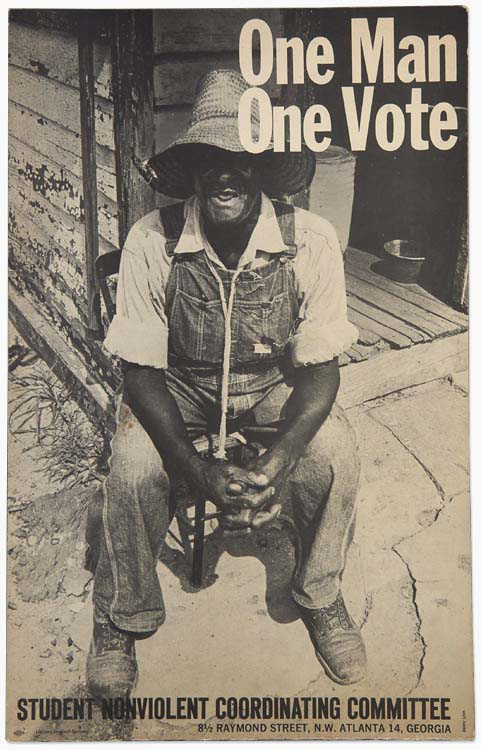 One Man ~ One Vote
Federal efforts to enforce voting rights are reluctant and ineffectual. Moreover, they focus on "equal application of the law." Since Mississippi law requires that prospective voters pass a complex and arcane literacy test, and the state's segregated Black school system has systematically denied an adequate education to the overwhelming majority of Blacks, if equal application of the law ever actually occurred it would simply result in disenfranchisement of a good many illiterate whites, and just a tiny increase in the number of Black voters.
In response to these realities, SNCC takes a radical step, it decides to challenge the entire concept of voter "qualification." Voting is about political power, not academic achievement. Since all citizens are subject to the laws and taxes imposed by elected officials they should all have a right to vote regardless of their education. If the power-structure wants voters to be literate, they should provide a public education system that teaches everyone to read and write regardless of race. SNCC's position is summed up by adopting the South African cry of: "One Man, One Vote," and illustrated by a poster of an old sharecropper.
Freedom Ballot
The November general election pits the segregationist Paul Johnson (Democrat) against the equally segregationist Rubel Phillips (Republican). With Blacks prevented from voting — and having little interest in supporting either candidate even if they could vote — COFO decides to hold another unofficial protest vote similar to the one they organized for the Democratic primary runoff at the end of August.
Named the "Freedom Vote" (or "Freedom Ballot"), the campaign begins on October 6 with a state-wide convention at the Masonic Temple in Jackson where an interracial slate of candidates is nominated to appear on the Movement's Freedom Vote along with the Democratic and Republican candidates. Heading the Freedom ticket is NAACP leader Aaron Henry of Clarksdale for Governor, and Movement activist Rev. Ed King of Tougaloo College for Lt. Governor.
The Freedom Vote campaign is based on the "One Man, One Vote" principle that all adult citizens should be eligible to vote. The campaign is designed to show that Blacks in large numbers want to vote but are denied the right to do so — and that the white segregationists elected to office do not represent Mississippi Blacks.
Freedom Vote voters first "register" by filling out a simple Freedom Registration Form which organizers carry door-to-door and make available in those churches, offices, pool-halls, and other locations that are willing to dare white wrath by supporting the Freedom Movement. Once "registered," freedom voters can cast their Freedom Ballot for the candidates of their choice. A state campaign office is set up in Jackson, more SNCC and CORE organizers are added to the COFO staff, and SCLC's Citizenship Schools program is expanded. SNCC member Mike Miller recalls:
[Though this] was obviously not the "legal ballot," everybody realized that it was a test of whether we can really get people to put their bodies on the line for the right to vote, because they would have to show up in a public place and check a ballot. And nobody really knew what was going to be the turnout for this thing. It was a very precarious place for the Movement to be, to face a test like this, which was very different from militant students or young people doing direct action. — Mike Miller. [16]
COFO activists, along with local volunteers (mostly young), fan out across the state to organize the Freedom Vote. The going is tough. Terror lies heavy on the land, people are afraid, Black churches, organizations, and businesses fear they will bombed or evicted if they allow Freedom Voting on their premises, and any kind of voting on the part of Blacks — even in an unofficial mock election — risks vicious retaliation from the white power- structure. And there are some counties, such as Issaquena, Amite, Neshoba, and Grenada that are simply too dangerous to enter, the risk of local supporters being murdered just too high.
Across the state, in county after county, police and sheriffs harass and threaten Movement activists. In Jackson, a cop shoves SNCC organizer Ivanhoe Donaldson into the back of a police car, draws his gun and points it at Ivanhoe's head, shouting, "You and the other goddamn Moses niggers around here ain't gonna git nuthing but a bullet in the haid! Black son of a bitch, I'm gonna kill you, nigger!" Noticing that there are witnesses, another cop suggests that this is not a good time or place for a killing, and Ivanhoe is released.
At a Freedom Ballot campaign rally in Hattiesburg, police cars circle the church with their sirens howling. Fire trucks add to the din, and firemen (all of them white, of course) storm into the sanctuary, claiming there is a fire. Shouting over the clamor, Aaron Henry defiantly tells them, "The fire within us cannot be extinguished with water!" When Freedom Ballot votes are cast in November, 3500 of 7500 eligible Blacks in Hattiesburg and Forrest County participate — the highest turnout in the state.
In late October, almost 100 students — mainly from Yale and Stanford, and most of them white — are recruited by National Student Association and Democratic Party activist Allard Lowenstein to come work as volunteers on the Freedom Vote campaign. They represent the first large influx of northern whites into a Mississippi Freedom Movement which is 99.9% Black. They share the work and the danger that Blacks have endured for years, some are arrested, some are beaten, but overall violence across the state drops noticeably during the two weeks they are in Mississippi. The white students also draw expanded coverage from the press, and with it increased political pressure on the Kennedy administration. The visible presence of federal law enforcement suddenly increases — but only temporarily. When the white students leave, so do the federal agents. As Lawrence Guyot put it: "Wherever those white volunteers went FBI agents followed. It was really a problem to count the number of FBI agents who were there to protect the [white] students. It was just that gross."
But the white students also bring culture clashes and ingrained assumptions that spark racial tensions between Blacks and whites within the Movement. Some of the white students from elite universities express attitudes — conscious or unconscious — of privilege, superiority, authority and assertiveness that rub raw against Black activists who have been putting their lives on the line for years.
In churches and other venues, Freedom Voting takes place from Friday, November 1st to Tuesday the 5th, with records kept so that no one can vote more than once. More than 80,000 people — four times the total number of Blacks officially registered to vote — defy the cops, the Klan, and the Citizens Council to mark Freedom Ballots. There is significant coverage in the national and northern press and increased demands that the Kennedy administration defend Black voting rights.
The Freedom Vote becomes a pilot program for future Movement political organization in Mississippi. It lays the foundation of a powerful, Black-led, state-wide, political organization that soon evolves into the Mississippi Freedom Democratic Party (MFDP), lays the groundwork for Mississippi Freedom Summer and the 1964 MFDP Challenge to the Democratic Convention in Atlantic City.
See Freedom Day in Hattiesburg for continuation.
For more information on the Mississippi Civil Rights Movement:
Books: Mississippi Movement
Web:
Mississippi Movement & MFDP A Discussion
Freedom Ballot — Mississippi
Mississippi Freedom Democratic Party
Mississippi Movement
Documents: Freedom Ballot Registration Form [PDF]
On November 22, President Kennedy travels to Dallas Texas where hostile white segregationists view him as a "race-mixing integrationist," a supporter of Black civil rights, and a Communist sympathizer. Prior to his arrival, thousands of Kennedy "Wanted for Treason" leaflets and posters are distributed by right-wing, and white racist hate groups. On the day he is killed, the Dallas Morning News runs a black-bordered full-page anti-Kennedy ad. White protesters heckle and dog the President's motorcade as it travels through the suburbs and city until he is shot to death on a downtown street.
Though the murder is quickly attributed to a leftist "lone-gunman," to this day many Freedom Movement activists believe that Kennedy's assasination was the result of a conspiracy involving, among others, white racists and right-wingers opposed to integration and Black civil rights.
Across the South, reaction varies widely. Ardent segregationists — including many white college students — are loudly jubilant, many openly celebrate the murder of a president whom they hated. Most Blacks are deeply grieved at the loss of a leader whom they saw as a protector and defender of civil rights, and on the walls of Black homes throughout the South, photos of JFK are added to those of Jesus Christ and Martin Luther King.
Freedom Movement activists on the front lines have mixed reactions to the assassination. Among them are those who had been drawn into social struggle by Kennedy's inspiring oratory, for some of these, his murder is a profound shock that shatters idealism and saps hope, but for others it results in renewed dedication to those ideals he articulated so eloquently. But many Movement activists are bitter over Kennedy's neglect of civil rights issues, his appeasement of segregationist politicians, his vacillation when it comes to enforcing existing laws, and what they feel is his betrayal of his own rhetoric. They do not applaud his death, but neither does it greatly move them.
See Atlanta Sit-ins for preceding events.
As the year 1963 draws to a close, SNCC, SCLC, and local students continue the effort to desegregate Atlanta's public facilities that began with the sit-ins of 1960. At a rally, Dr. King accuses the city of having fallen "...behind almost every major southern city in its progress towards desegregation," and he warns that its "progressive" image had "... become a tranquilizing drug to lull us to sleep and dull our sensitivity to the continued existence of segregation. This cancer of segregation cannot be cured by the Vaseline of gradualism or the sedative of tokenism."
Young activists sit-in at the City Hall cafeteria, Toddle House and Krystal restaurants, and Holiday Inn. More than 20 are arrested. On December 21st, Oginga Odinga — co-founder of the Kenya African National Union (KANU) and a leader in the struggle to free his nation from British colonial rule — arrives in Atlanta on a State Department tour. His government shepherds fail to schedule any meetings with Atlanta civil rights activists, so SNCC sends a delegation to the Peachtree Manor, one of the very few hotels in Atlanta that accepts Black guests. Odinga greets them warmly as fellow freedom fighters and agrees to accompany them next door to the Toddle House for coffee, where they are told, "Sorry, but we don't serve colored people here."
When the SNCC members refuse to leave they are arrested. They sing We Shall Overcome and Odinga responds with Uhuru! the Swahili word for "freedom." Odinga later tells reporters that the racial situation in the U.S. is "Very pitiful," and draws parallels to the struggle overseas, "[The U.S.] practices segregation which is what we are fighting in Africa." The U.S. State Department, which is trying to woo the emerging nations of Africa into the "Free World" anti-Soviet camp, is not amused.
The meeting makes a deep impression on SNCC. Freedom Singer Matt Jones writes the song Oginga Odinga to commemorate the event, and SNCC Field Secretary Charles Cobb later writes:
It was in '63 that we really started to become aware of Africa, as I remember. Oginga Odinga, who was at that time the vice president of Kenya, was touring the United States, and one of the places he visited was Atlanta, Georgia. A whole bunch of us went to see him, just because he was an African leader. There was no political assessment of Kenya, or any of that. He was a Black guy who was a vice president of a country, and we had just never seen that. He was staying at some posh hotel in downtown Atlanta, and he saw us. We had this talk, and shook his hand; it was a big thing. Afterwards we decided to go have coffee at a restaurant next door to the hotel, and we were all refused service. We were kind of high on meeting this Black leader, and so naturally we refused to leave the restaurant, and we all got arrested. Oginga Odinga became a known name in the organization. There were songs written about him. Because of this incident, discussion started. — Charles Cobb. [17]
See Atlanta Sit-ins & Mass Arrests and SNCC Delegation to Africa for continuation.
For more information on the Atlanta Civil Rights Movement:
Books:
Georgia Movement — Atlanta — Albany
Student Nonviolent Coordinating Committee (SNCC)
Web:
Atlanta Movement
Student Nonviolent Coordinating Committee (SNCC)
1. SNCC The New Abolitionists, Howard Zinn 2. "I'll Never Forget Alabama Law", William Douthard 3. March On Washington: August 28, 1963, Thomas Gentile 4. Walking With the Wind, John Lewis 5. The Making of Black Revolutionaries, James Forman 6. "The Day They Marched," Ebony Magazine October, 1999 7. "The March on Washington Remebered by Bob Zellner 8. "The March on Washington Remebered by Joyce Ladner 9. Like A Mighty Stream: The March on Washington, August 28, 1963, Patrik Henry Bass 10. Bruce Hartford 11. "Why Did the F.B.I. Hold Back Evidence?" New York Times, May 3, 2001 12. How to Prepare for the LSAT, 11th Edition, by Jerry Bobrow. Barrons , 2005 13. "Final Report Select Committee to Study Governmental Operations with Respect to Intelligence Activities" U.S. Senate, 1976. 14. Chuck Bonner & Betty Mae Fikes Interview 15. Condensed and adapted from SNCC The New Abolitionists, Howard Zinn 16. Mississippi Movement & the MFDP ~ CRMVet Discussion 17. No Easy Victories: African Liberation and American Activists over a Half Century, 1950-2000, Minter, Hovey, & Cobb 18. "Election Day Report," Mike Miller, Southern Regional Council 8/13/63 19. General Prospectus for the Establishment of a Free Southern Theater 20. SNCC 50th Anniversary Commemorative Program 21. "Stolen Girls" by Donna M. Owens. Essence, (June 1, 2006) 22. Memories of the Southern Civil Rights Movement, Danny Lyon 23. Don Harris Oral History 24. Don't Stick Your Nose in Other Folks Business, Bob Mants 25. John Lewis' Speech, March on Washington, August 28, 1963 26. Americus, GA: Sheriff Fred Chapell and "Slappy", John Perdew 27. An Effort to Define Self Through Involvement in the Civil Rights Movement, Peter Titelman 28. The Selma Campaign, 1963-1965, Wally Vaughn 29. "The Rev. L. Francis Griffin and the Struggle for Racial Equality in Farmville, 1963", Lee & Daugherity.
|
|
© Bruce Hartford
Webspinner:
webmaster@crmvet.org
(Labor donated)
 1963 (Jan-June)
 1964 (Jan-May)